
By Design

Solomon wrote, “Guard your heart above all else, for it determines the course of your life” (Proverbs 4:23, NLT). Good words, wise words. Solomon was stinkin wise. First Kings 4:31, makes mention of his wisdom and lists those (by design) he was wiser than. In this list, among others, we find Ethan the Ezrahite. Can you imagine going down in permanent history, basically being said of you, “Ethan, oh he’s one of those not so wise guy Dudes!” Overshadowed by another, someone—something other than him?
We live in a society where there are comparative views of just about EVERYTHING. “This tastes better than that. Over there it is more spacious than here. He sings better than him. She is prettier-thinner-gifted and smarter than her. They have much more than us.”
Comparison.
Even though Solomon was granted wisdom and a discerning heart by God (See conversation in 1 Kings 3) reading this narrative of Ethan, we can’t stop there! Scholars believe Psalm 89 is attributed to this same Ethan the Ezrahite. He is divinely granted canonized parchment space of fifty-two verses. He writes of God’s steadfast love. Of His faithfulness of covenant, with strong worshipful words, “I will sing of the LORD’s great love forever; with my mouth, I will make Your faithfulness known through all generations” (v1). He goes on to declare “You have made … established… crushed… scattered … founded, and created…” THAT is some engaging declaring!
Overshadowed Ethan? I think not. Yes, perhaps not as wise by design as Solomon. But his words are gripping and stirring. He was declaring, worshiping—Ethan. Might I add, Ethan was his own man! And, YES generations later he is still making God’s faithfulness known!
Through the scriptures we see folks standing out, sometimes very quietly. By design Bezalel and Oholiab worked skillfully on the construction of the Tabernacle. By design courageous Abigail intercepted a revengeful King Daivd. By design Hosea set an example of redeeming love. By design Dorcas did good and helped the poor. By design, John outran Peter at the tomb (HA!)*
Those in my personal life; By design, Kathy has a welcoming heart of hospitality. By design, Lori is artsy and creative. By design, Deanna has a gift with preschoolers. By design, Nancy shares her Godly wisdom found in experiencing Jesus. By design, Dorothy has a flair for texting emojis (HA!)
May we be so inspired. Our skills, God-given abilities and accomplishments MATTER! It is not a matter of comparison, but one of living by design. His design. May we celebrate God’s design with one another!
Who can we celebrate this week?
In Him, DeDe (“Let us consider how we may spur one another on toward love & good deeds” – Hebrews 10:24).
*Exodus 36; 1 Samuel 25, Hosea 3, Acts 9, John 20.
Obedience

“It shall come about, if you listen obediently to My commandments which I am commanding you today, to love the LORD your God and to serve Him with all your heart and all your soul” (Deuteronomy 11:13, NASB).
The narrative continues to explain the blessing and cursing of obedience or the lack of. Moses conveys the importance of what God is saying about obedience with repeating himself, (in the Hebrew) “shama, shama” (listen obediently). In the Hebrew culture, hearing and obeying are synonymous. I appreciate the wording of one study resource, “It behooved them to be careful to attend to His commandments and to obey them.” We need a whole lot more “behooving”* in our current culture.
What comes to mind is the foreign concept (hear and obey) to the average pre-teenager when instructed to clean their room. (Anyone?) Soon emotional declarations are made that they HAVE heard, yet the room sits seemingly neglected with items thrown to the four corners. However, I guess often, I too do the same thing in my obedience (with just a bit less hormonal energy).
How well are we (I) hearing God? Are we actually doing what we’ve heard? What we’ve read in scripture? Is it a thorough obedience? How often is our obedience to God contingent to convenience. Conditional to our perspective. Determined by the emotion of the day (or the moment). Or our obedience happens when favored only with our preference.
Recently I sat down with a lovely God-loving couple. They, being married fifty years, shared their differences, likes and successes. From their depth of maturity and love for God and His word—challenged me! They spoke of trusting God. Trusting God on a level I am faced with is only found in boatloads of surrender. Surrender. Surrendering that HE cares so much more! Trusting HE is working!
I believe Moses’ words above, speaking of obedience, leans heavily with the principle of surrender. To love God with ALL our heart and ALL our soul comes only when we choose to sidestep self and focus fully on God—obeying Him. Jesus addresses this, “If you love Me, you will obey what I command” (John 14:15). We say we love, but … Lips and life must always match! (OUCH! Painfully, OUCH!)
Challenge indeed.
When we think of our heart, we usually think of the cutsie red shaped object sent on Valentines Cards. Yet cutsie, in reality, it is not. God was serious when designing the human heart. When the scriptures speak of the heart, it refers to the entire disposition of the inner person. Our seat of emotion and the center of our understanding, describing the place where the rational thinking process occurs. The soul is not only the mind, will and emotions as well, but conveys the person as a whole. Our love for our God is to permeate to everything—from everything within us.
With the challenge to surrender, trust and obey, I personally am reaching back and borrowing from Solomon’s answer when God said, “Ask Me for anything.” Solomon’s response, “Give me an understanding heart so that I can govern Your people well and know the difference between right and wrong for who by himself is able to govern this great people of Yours?” (1 Kings 3:9, NLT). I may not have a people to govern, but I DO have myself to govern and govern well—according to God’s word, enabled by His Spirit. (Not prioritizing my convenience, perspective, emotion or preference). While understanding is a gift of God, it does not come automatically. The possession of it requires persistent diligence.
How about you? Does your obedience track record look like a pre-teen’s room? There may be somewhat evidence of an attempt but in all honesty, your hearing and obeying only lends to stuffing things under and in and tossing to corners.
May we all keep surrendering, pursuing understanding, and trusting Him—from everything within us.
Obedience.
In Him, DeDe (“Let us consider how we may spur one another on toward love & good deeds” – Hebrews 10:24).
Resources: The Complete Word Study Dictionary–Old Testament, Bible Knowledge Commentary, Theological Word Book of the OT, ESV Commentary Notes, NET Bible Commentary Notes, Matthew Henry Commentary, Precept Commentary, KJV Pulpit Commentary, Websters Dictionary 1828 and any other biblical geeky place I looked at and forgot to jot down.
*Behoove: To make it advisable or necessary and proper to do so, for their own good or that of others.
Rest

Jesus sends the twelve disciples out to minister without Him (Mark 6:7-13) to put into practice what they’ve been learning being with Him. When the disciples had returned from teaching, healing and delivering the people, they were exhausted. In their sharing of the events, there was so much activity, they didn’t even have time to eat. Jesus tells them, “Come with Me by yourself to a quiet place and get some rest” (v 31). They get in a boat and head to a solitary place. Notice Jesus was very specific. He didn’t say “Go away—take some time off, I’ll see you on the other side in a few days.” He wasn’t offering options. He said, “Come with Me.” It was a now invitation.
The narrative doesn’t say it, but can you almost imagine the boat ride over. They, being weary and already gave their report to Jesus: there was no joking, no exclaiming of dustless sandals (see v11 below) and no telling the ever so energetic Peter to sit down. Just quiet and the lapping of the water on the boat—and Jesus.
Presence.
Perhaps YOU are exhausted, exhausted from the stuff. Worn out from routine, serving and loving. Rest. Follow this example: “Come with Me by yourself to a quiet place and get some rest.”
By the way, we can’t stop there. That solitary place? Before they even get to shore, thousands of folks show up. Jesus having compassion, teaches the crowd. As it gets late, and folks are hungry, He instructs the disciples to gather the MANY in an organized manner. After praying, He takes what little food they found and hands the broken bread and fish to the disciples to feed the multitude.
Rest, getting ready for the next BIG thing. Take the invitation of quiet and Presence when you can!
For our growth and His glory.
In Him, DeDe (“Let us consider how we may spur one another on toward love & good deeds” – Hebrews 10:24).
V11 “And if any place will not welcome you or listen to you, shake the dust off your feet when you leave, as a testimony against them.” (Part of Jesus’ instruction when sending the disciples out).
* Photo credit: Horacio Cardozo
If You Say So
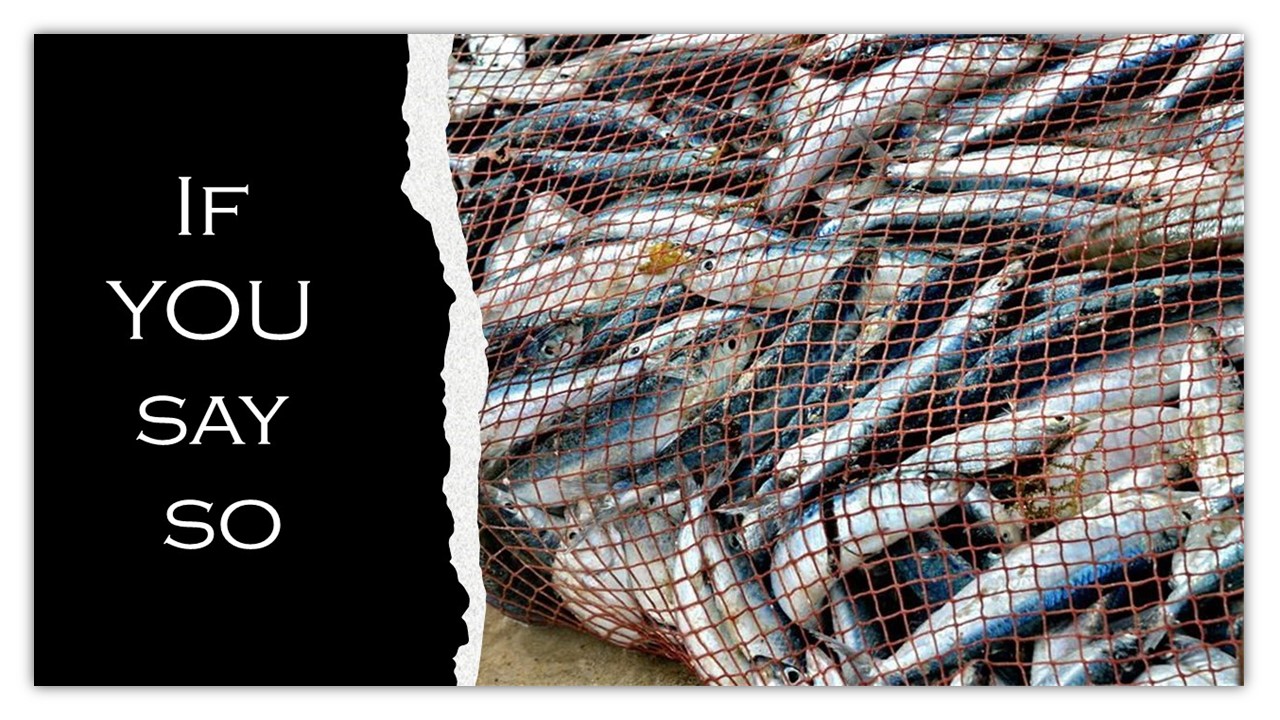
After Jesus had taught from Simon Peters’ boat, (Luke 5) He told him to cast his fishing nets out where it is deeper. Peter responded they had already fished all night, “But if You say so” (v5). They went out and put their nets in deep water. The catch was so large, the nets began to break. Peter had to get other fishermen and their boat to help. Both boats are now full. This miraculous catch caused all those observing to be in awe. Two of these awestruck men were the brothers, James, and John. Going ashore, they all left everything to follow Jesus.
WHAT IF? (For the sake of making a point).
What if Peter had declined to do what Jesus said, “It’s ok, I’m a professional fisherman, I got this” and went about his business? Ignoring the Master’s instruction. What did he miss? (What did the others miss?)
WHAT IF?
Peter delayed his obedience? Delayed it an hour or two? “I’ll get to it; I’ve got something I need to do first.” Perhaps by then James and John (in the other boat) would have been out of ear shot or too far away to help and the nets would have broken. The fish, the great catch, slipped away back into the deep. Perhaps their delay missed the school of fish that now travels in another direction. A divine encounter missed. A missed opportunity.
WHAT IF?
Peter didn’t go all the way out into deeper water, stopping short, dropping the nets in shallower water. Yes, he had let down the nets, but NOT in the deep water. Reluctant to fully obey—devaluing Jesus’ words (thinking he knew better). Full obedience expresses value to what is said, and to whom said it. Partial obedience is disobedience. (OUCH!)
There is a strong principle for us: OUR obedience to Jesus does not just load up our boats of blessing—it causes opportunity for others to be blessed and in awe. Awe of Him. Our listening and doing what Jesus says (now) can lead others (and ourselves) in divine appointment. Our obedience is not for us alone.
May we not decline, delay or devalue what Jesus says.
“But if You say so” (My Lord, I will…)
Point to Ponder.
In Him, DeDe (“Let us consider how we may spur one another on toward love & good deeds” – Hebrews 10:24).
Mis-Give What Belongs to God

The Nazirite vow. The Nazirite lifestyle. Generally done by individual choice (See Numbers 6) and according to the Mishnah, (Ancient written collection of the Jewish oral traditions) it states the vow lasted for at least 30 days. Scholars believe this may be what Acts 18:18 is referring to when Paul was “in Cenchrea he had his hair cut, for he was keeping a vow.”
However, two Old Testament guys, Samuel (1 Samuel 1:11) and Samson (Judges 13:1-5) were presented to God by their parents with evidence of Nazirite elements—tying them to a lifetime of service to God. In the New Testament—John the Baptist (Luke 1:13-17).
We are most familiar with the Nazirite, Samson. He was conceived within Nazirite conditions and raised a Nazirite, set apart from birth. He was to abstain from anything grapes. Have no contact with a corpse and not cut his hair (Numbers 6:3-5). At the end of the vow, he was to offer his long hair at the temple as a sacrifice to God (v18). All this was to be a lifestyle for him (not just the mindset of a weekend fast) “the boy shall be a Nazirite to God” (Judges 13:7).
He knew. Samson knew better than his behavior. He ate honey from a carcass (and gave some to his folks). THEN hung around Delilah from the Valley of Sorek (which means, the Valley of the Vine). RICH vines, producing purple grapes. Samson, a Nazirite—WHAT is he doing messing around the Valley of Vines!
DUDE!
We do see God bless him with strength. Mighty strength. However. Samson, seduced by Delilah’s sweet voice, offered his hair to her (rather than God) by telling her the secret to his strength. She had it cut off. His vow was fully broken. He sacrificed improperly. Which led to his lack of strength and ultimately his death. (You can read his whole story in Judges 13-16).
Just like the Nazirite vow, we too, as Christ followers, the redeemed, are called to a set apart lifestyle—a holy people consecrated to God, calling us to a holy life (1 Pet 1:15; 2:9-12). Being set apart does not (NOT) mean playing with the line drawn in the sand (or playing in the vineyard) and seeing how close we can get without crossing it, touching, or sampling it. Or playing with our calling like a toy and tossing it around.
Oswald Chambers wrote, “The first thing we realize when we come to Jesus is that He pays no attention to what we prefer. We have the idea that we can choose what to consecrate to God” (My Utmost for His Highest). God is holy and sovereign, He is “other.” The lifestyle of being “set apart” (consecrated) is just that, set apart, all in, to—other. REGARDLESS of what the world does, what the world says. Regardless of seducing voices. Voices that offer options, choices, and redirected desires that are contrary to God, and His word.
Peter wrote, “Stay alert! Watch out for your great enemy, the devil. He prowls around like a roaring lion, looking for someone to devour” (1 Peter 5:8, NLT). Peter is painting an ugly picture of an adversary with an extremely malicious intent on devastating and destroying lives. Devour means to swallow (to gulp down) yet conveys also to assimilate, absorb, to overwhelm—to take in and incorporate as one’s own. “Stay alert! Watch out for your great enemy!”
May we be ever so careful and learn from Samson. Be alert, our behavior match what we know, discern voices and not mis-give and mis-live what belongs to—God.
Side note: Additional “mis-giving” – When the Israelites gathered their gold ear rings to help Aaron with the golden calf. Later, they were instructed to bring their gold to help build the Tabernacle (God’s dwelling place). Wonder how that felt when some were empty handed due to their mis-giving. (See Exodus 32 and 35). Mis-giving what belongs to God.
Point to ponder.
In Him, DeDe (“Let us consider how we may spur one another on toward love & good deeds” – Hebrews 10:24).
Slow Down

A couple of years ago, I had the opportunity to help teach a discipleship class on Bible translations and offer a brief overview of how to study the bible. Hermeneutics is one of my favorite topics. What? (Google is your friend). I wanted to come out of the gate with a fist full of lists of the most excellent and current resources Amazon can provide! “And you too can have it delivered right to your door!” But instead, I opened with “S-L-O-W D-O-W-N!”
We are a grab and go society! We fly into circumstances and jet out just as fast. We do the same with our devotions and study time. We seem more concerned with that glorious moment of checking the box in our daily reading list that we actually miss understanding what we’ve read. Missing important details. Those details paint God’s wonderful love story. Details that boldly tell us what pleases Him. Instead, we offer up a hurried pit stop and then we close the Book, put our half-drunk (now cold) coffee on the counter and head out into our day. If we think of it (just maybe) there is a quick over the shoulder glance with a rushed “Thanks Lord.”
Slow down.
The Bible is a spiritual book, not to be all-mystic and such, but it is— spiritual. Paul says it is “God-breathed and useful for teaching, rebuking, correcting and training in righteousness” (2 Timothy 3:16). Folks, it’s our manual. As the Pastor of Hebrews declares it is “living and active… it judges the thoughts and attitudes of the heart” (Hebrews 4:12). Why rush the divine process. Giving Holy Spirit opportunity to speak to our alignment with His Word, like when a banker holds up to the light a $20 bill, looking for counterfeit markings. His word is our standard.
Slow down.
Pray before we even open The Book and invite the Author to walk us through it. Pray while reading, “Show me Lord, speak, teach, grace my heart to hear and heed.” In doing so, we not only read the Word, but we allow the Word to read us!
I would offer, if possible (without creating too much anxiety with the NEED to check that box) —read smaller portions. Read as if once we close the book, we are now going to share with someone (in our own words) what we just read. THIS will help us read differently. Look for details differently. Hear differently. God designed His holy writ to be interactive. The Psalmist repeated multiple times in the beloved Psalm 119, “Teach me” as he describes his love for God’s word.
As we close that wonderful Book, pray too, asking Holy Spirit to wallpaper our heart with what we just read. May it be our heart’s view for the day. Tomorrow? With great anticipation and expectation—we will do it again.
Slowing down.
In Him, DeDe (“Let us consider how we may spur one another on toward love & good deeds” – Hebrews 10:24).
Don’t Sabotage

I once heard the story of a study group of Rabbinical Hebrew students, as the session came to a close, one student handed a friend a black book and said, “Read this and tell me what you think.” Later that evening the friend remembered the book. Reaching for it, he sat down. Opening it, he began to slowly read. Immediately frustrated, he stopped reading. After a quick pause, he looked down and began again. This time, he rose and said out loud, “In the beginning God created the heavens and the earth. PERIOD” He exclaimed with great conviction, “No! He’s not finished yet!”
The black book he was reading was the English King James Bible.
You see the original Hebrew manuscripts had no chapter or verse divisions, and no punctuation as well. It was/is custom and tradition to read until the action or thought was complete. In this case, “In the beginning God created the heavens and the earth…” (no period) they would have read on through to “…By the seventh day God had finished the work He had been doing; so on the seventh day He rested from all His work (Genesis 2:2). I so appreciate the focus.
By principle, how often do we too attempt to put a period (completing an action or thought) where God is NOT finished yet.
What may seem to be a mess to us—God is still working.
Recently I have taken up walking again for exercise, but as I get a block away from the house, I find I have a slight limp. In 2021 I experienced a fall that tore my hamstring. It wasn’t just a bruise, or strain or sprain. It tore. Painfully, black and blue, couldn’t walk—tear! It was such an impressive tear the orthopedic surgeon had to get an associate to come and look, turning my appointment into an instant show and tell.
After a time in the wheelchair and camping out downstairs in our living room with my husband, I began physical therapy. My therapist said something to me as she watched me walk across the room, I will never forget. “Stand up straight. Don’t limp. I know it may hurt, but you need to train the muscle to work the way it was designed.” Even though it may not have healed correctly or completely, as I walk today, I am not faking it as I focus on this, I am “faithing” it. Assured there is healing in the training.
So, it is with life. I am learning there may be incomplete or incorrect areas that need healing. God isn’t finished yet. Paul wrote, “Being confident of this, that He who began a good work in you will carry it on to completion until the day of Christ Jesus” (Philippians 1:6, emphasis mine). Genuine spiritual progress is rooted in what God has done, is doing, and will do.1
Believe Him.
Don’t stop short. May we not attempt to put a period where God is not finished yet or attempt to sabotage our healing because it is too much work and too painful.
God is still working.
Yet, He’s counting on us doing our part as well. I can almost hear His whisper as He watches our walk, “Stand up straight. By faith, don’t limp. I know it may hurt, but you need to train and follow My design.”
In Him, DeDe (“Let us consider how we may spur one another on toward love & good deeds” – Hebrews 10:24).
The above is an excerpt of my recent teaching when I had the honor of speaking to the women of Abundant Life Center in Jefferson, Oregon.
___________________________________
1 ESV commentary on Philippians 1:6
Wait! There’s More!

I am remembering a time when I was visiting a church when the pastor, full of Pentecostal energy, shared vigorously from Psalm 136. Twenty-six times the Psalmist declares, “His mercy endures forever.” Some translations, “His lovingkindness endures forever.” Oh, it does! God’s mercy is unending. Matchless in every way. It can be seen from the beginning of mankind’s existence and has no vanishing point in the future. Within the twenty-some minutes of sharing, the pastor repeated the blessing of God’s mercy, then “In closing…” He said, “His mercy endures forever.” As the folks stood to leave, preparing for the trek home to the roast in the Crockpot, I wanted so BADLY to stand to my feet and yell, “Tell them!” (All eyes on the crazy visitor lady in the back.) “Wait! There’s more! Pastor! Don’t stop here!”
Tell them that the Hebrew language is full of imagery. YES mercy! But there is more. Just like there is “sunrise” with just a glimpse of a sliver of light peeking over the horizon, then there is SUNRISE with colors so vibrant you stare in unbelief at the magnitude of His creation. Colors spilling over each other as it dances across the sky in tones that if we are still enough, so very quietly still—it could almost be heard. Today, with the Pastors’ sharing, we were just—peeking.
His mercy endures forever. Mercy is “hesed” (in the Hebrew). Scholars find it extremely difficult to translate into English because there really is not an equivalent word. The English Bible uses many different words in an attempt to express its meaning in each context. Words such as lovingkindness, steadfast love, goodness, favor, loyal love, kindness, faithfulness, truth, justice, righteousness, mercy and yes—grace.
Mercy and grace. God’s mercy is withholding what we do deserve, where His grace is giving us what we do not. One hand pushes forward in giving, while the other holds back in restraint. The ultimate divine coordination—THAT is our God! Because of His love for us, His commitment to covenant, and His value of relationship, our God interacts with hesed. It is deep, wide and continuing.
Agape (love) is the New Testament (Greek) equivalent to hesed. Paul wrote;
“I pray that you, being rooted and established in love, may have power, together with all the saints, to grasp how wide and long and high and deep is the love of Christ, and to know this love that surpasses knowledge–that you may be filled to the measure of all the fullness of God” (Ephesians 3:17-19, NIV).
Jonah knew God’s hesed, saying “O LORD, is this not what I said when I was still at home? That is why I was so quick to flee to Tarshish. I knew that You are a gracious and compassionate God, slow to anger and abounding in love (hesed), a God who relents from sending calamity” (Jonah 4:2, emphasis mine). Ok, maybe Jonah needed an attitude adjustment, (Thus the large fish story) but he knew, he understood, and observed how God operates.
God’s lovingkindess is His willful, purpose-filled direction toward man.
Yes indeed, it is worthy of repeating in twenty-six verses, “His mercy (insert all those words describing His amazing character here) endures forever.” What a challenge, to be aware and be in awe of God. It is enough to make us close our eyes, bow our head and sit quietly and take in His brilliant sunrise!
His hesed endures forever.
In Him, DeDe (“Let us consider how we may spur one another on toward love & good deeds” – Hebrews 10:24).

Celebrate

We are all image bearers. In Genesis chapter one, it says God created mankind in His own image and likeness, male and female (vv26-27). Image is form (appearance) likeness is function. We were originally designed to look and act like our Creator. This last Mother’s Day weekend, we celebrated moms. We celebrated the God nature in us. We are physically designed and spiritually designed to nurture and guide.
Yet, I’d like to take the banner and run further. Regardless of where we (women) fall on the feminine spectrum: Princess to tomboy. Small to large. Young to old. We are women, we are female (regardless of the world’s confusion). Proverbs 31 (don’t groan) gives examples of a Godly woman. It can be overwhelming and exhausting reading the list. BUT. It is not a job description. It is a—celebration. (Stay with me, this is good).
Proverbs 31, at first glance it is strongly assumed it is written by a man. Well, it is … kinda. Most jump straight to the popular verses, beginning at verse ten and neglect the opening (vv1-9). It is a man telling what his mom taught him. One Jewish tradition claims (many scholars agree) the mom may have been Bathsheba teaching this to her son, Solomon. But we really don’t know. Yet, this mother tells her son to not waste himself on wine. Don’t be passive, be bold, speaking up for the poor and helpless. She tells her son not to spend himself on women (plural). THIS is what a king does.
Mom goes on to say, but this “woman” (singular) she is worth far more than valuable jewels. A woman who is faithful, kind, prepared, charitable, hardworking, smart and confident, as the following verses declare.
Verse 10, (paraphrasing) “Who can find such a woman of virtue.” Many translations say, “wife” due to the context that she has a husband. In the Hebrew (virtue) “chayil” (pronounced with a guttural “high-el”) can mean brave, excellent and noble. It conveys a military tone as well, “one of war” —a warrior. A warrior fights for a cause, for a standard, even if the standard is as basic as “God said.”
Of the 235 times “chayil” is used in scripture, all refer to either God or men or a man. All except—three, three women. Isn’t it interesting that scripture uses the same word to describe both a man of valor AND a strong woman.
Of the three, first, here where Mom tells the son, a good God-fearing woman, a kind, STRONG woman is worthy of your interest, and of your strength. The second is found in Proverbs 12:4 “A wife of noble (chayil) character is her husband’s crown.”
The third, Ruth. In Ruth chapter three, just before Boaz is about to begin the process of taking her as his wife, he says the people of his village know her to be “eishet (woman) chayil.” “You, Ruth, are a woman of strength.” Your reputation speaks highly of you. Ruth, unlike the Proverbs 31 gal, when this was said to her, is not married (she was, he died). She does not have any children.
Ruth goes on to marry Boaz and together they have a son named Obed. He had a son named Jesse – he had a son named David. This “woman of strength” was King David’s great-grandmother. David went on to have a son named Solomon. Not to mention (but I will) according to Jesus’ genealogy (in Matthew 1) Boaz’s mother was Rahab. Take a moment and let that sink in. Rahab is part of the redemptive story!
A Godly woman of noble character as described in scripture, (beyond the stereotyped Proverbs 31) is both married AND single (and a widow). She has children, while others do not. Some have a messy past that God has redeemed, a past He can redeem. All women are to be celebrated. Do not allow others to define you or frame you. Ladies, we tend to be our own worst critic. May we stop comparing and begin celebrating. What a WIDE variety of women we are.
Be blessed in your image bearing—to the glory of God.
In Him, DeDe (“Let us consider how we may spur one another on toward love & good deeds” – Hebrews 10:24).
(I shared the above on Mother’s Day Sunday at Abundant Life Center in Jefferson, Oregon. If you’re ever in the area, come see us—a great group of Godly folks).
Please note: It is the Jewish young men who are encouraged to memorize Proverbs 31, NOT the young gals. It is also tradition: at the Shabbat meal the men sing the Eishet Chayil (traditional Proverbs 31 song) to the matriarch and the women of the family, they celebrate them—weekly.
What is in Your Hand?

“I will praise You as long as I live and in Your name, I will lift up my hands” (David, Psalm 63:4). “Hands” literally means the palm, emphasizing the EMPTY hand. “Be still and know I am God” (Psalm 46:10). “Be still” in the Hebrew conveys the imagery of letting something drop, cease striving with fisted hand. The hand that was once tight fisted, holding on to stuff—we let it go! Giving God room to move, to fill and to use. God won’t pry it out of our hand. He waits.
What is in our hand? It could be a literal holding of something we need to give up honoring our love walk with Jesus. Or metaphorically speaking those things we hold tight, whether a mindset, attitude, or heart condition. What do we need to let go of?
Another consideration of the hand; Remember God asked Moses “What is in your hand?” (Exodus 4) He was carrying his staff. Something of purpose, useful to Moses. God used it (many times). I love books, mostly geeky theological books, yet I appreciate a good CLEAN historical fiction novel as well. God can use those (in my hand). May we be aware of what we choose to put in our hand.
Not to mention (but I will) may we be aware of what we reach for. I love meaningful symbolism. I wear a small simple gold ring on my right pinky, I have for many years. Being right-handed, I wear it to remind myself to be aware of what I reach for. “He who has clean hands and a pure heart… will receive blessing from the LORD” (Psalm 24:4-5). A true challenge to integrity—integrity of motive and action.
The empty hand raised heavenward in prayer and worship symbolizing our surrender and longing to receive. Our raised hands with the sincere intent, indicating God is high above—over all we are, all we have, all we want. Also, our hands purposefully filled at times and willingly commissioned for God’s use.
What is in your hand?
In Him, DeDe (“Let us consider how we may spur one another on toward love & good deeds” – Hebrews 10:24).
Additional Note: The phrase kept coming to mind for me, “Caught red-handed.” “Red-handed” has its roots in the 15th Century in Scotland, when first referenced, meaning literally being caught with blood stains on your hands after a crime. Hm. So much spiritual application can be made.
Breathe

I am reminded of a time a few years ago, (and resonating of recent) when walking into church rather tattered from the week that led to that day. I took my seat (5 rows back, first seat in). Placing my Bible next to me, the first thing that captured my attention was the quiet melody playing over the sound system. It was familiar and soothing, “As the deer panteth…” It was then, I felt the Lord impress on me, “Just breathe!” As the worship began, we all stood. I closed my eyes and did just that: Took a deep breath. Overwhelmed with His presence, I was reminded of—the breath of God.
How often do we find ourselves in survival mode? Barely making it. We feel our existence evaporating with each step forward. As the day goes on, we find ourselves unsuccessfully reaching and grabbing for anything solid. Thinking, “If I can just make it through this day. Through this season. To the next paycheck. See that person. BE that person. Get this done—that done. Clean this. Lose this—gain that.” BREATHE.
Just breathe.
In pondering this, (it may sound totally silly) I began looking at our breath and the ramifications of the lack of oxygen that takes place physically. How it affects us and how long it takes for a body to die. Not to be morbid or anything, but I feel it has quite a few similarities to our spiritual man.
In all the medical jargon, I found this quote: “A lack of oxygen to the heart muscle can cause heart attacks, and even if the individual survives the anoxic event (complete depletion of oxygen), there may be damage to the heart that proves deadly.” This doesn’t even speak of damage to the brain, where rationality is determined. There are also “quiet” symptoms that are attributed to a lack of oxygen as well: Depression, irritability, and irrational behavior. Anyone?
Just breathe!
Genesis 2:7 “And the LORD God formed man of the dust of the ground and breathed into his nostrils the breath of life and man became a living soul.” Our bodies were made of the dust, earth—biological. The soul was not made of the earth. So, earthly things cannot quench the hunger of the soul, (regardless of how much kale we eat) nor can the soul continue to survive. It is only the breath of God that feeds and nurtures the spiritual man! (Read that again). “It is ONLY the breath of God that feeds and nurtures the spiritual man!” It is divinely birthed and divinely maintained.
God is just BRILLIANT! He gave us life, we HAVE to go to Him to survive.
Like that of our physical body, so it is with our spiritual man. We NEED to breathe. Without a constant intake of God, the ramifications can prove damaging if not deadly. I believe we all have people in our lives that once were thriving-active, God-loving folks. But somehow, somewhere along their spiritual timeline—they stopped. They stopped reading God’s word. Stopped fellowshipping with other believers. Stopped believing God and stopped breathing God. Now, where are they?
How often do we seek things, people, position, and even events to satisfy our deep longing, and cravings? Without God’s breath and presence in our life, we are an empty dusty vessel. God initiated this for mankind, now we by invitation in turn seek that breath.
Just breathe.
Paul spoke to this in 2 Timothy, “Every part of Scripture is God-breathed and useful one way or another—showing us truth, exposing our rebellion, correcting our mistakes, training us to live God’s way. Through the Word we are put together and shaped up for the tasks God has for us.” (3:16-17 paraphrased, The Message). And the Pastor of Hebrews wrote, “For the word of God is alive and powerful. It is sharper than the sharpest two-edged sword, cutting between soul and spirit, between joint and marrow. It exposes our innermost thoughts and desires. Nothing in all creation is hidden from God” (4:12-13a NLT).
Just breathe.
Have we found we can’t seem to catch our spiritual breath? Are we low in emotion, irritable and even find we are being irrational or treating others unkindly? Are we apathetic about spiritual things? Or how about walking to the “frig of life” looking for something to satisfy us. If we are to survive, let alone THRIVE spiritually, we need God’s presence and His word to do so. When was the last time we quietly spent time with our God? Prayed. We invited His presence. We wholeheartedly pursued Him, His qualities? When was the last time we opened His word and really, truly, saw beyond the printed pages, and breathed Him in?
Just breathe.
In Him, DeDe (“Let us consider how we may spur one another on toward love & good deeds” – Hebrews 10:24).
Psalms

Recently, I have been working through the Psalms in my devotion time. Each morning it is like cracking open a treasure filled piñata where beauty and devotion come tumbling out. God’s devotion to us is bright and brilliant. Like that of opening a curtain to a sunny new day. Each reading, I set myself next to the Psalmist. I follow along as the author dips their pen and leans in to scratch out (regardless of their troubled circumstances) heart filled praise and worship.
God’s character is flawless, radiant, and holy and cannot become separate from His being. Yet He “Stoops down to look on the heavens and the earth” (113:6). He watches over the righteous, fills hearts with great joy, makes us dwell in safety and searches our mind and heart. He brings us out, stills our storms and shelters us. He restores, guides, leads, heals, satisfies, and—renews. He redeems, comforts and rescues. (I can keep going, so I will). He is compassionate, gracious, and merciful. My God examines, forgives, and covers. He answers me and makes me GLAD!
I just love Psalms!
I, like the Psalmists, in turn—sing, praise, shout, believe, extol, and sacrifice. I cry out, take refuge, and give thanks. I set my heart, trust in Him and walk about in freedom.
I am learning through the Psalms. I do not seek God’s hand as to receive from Him, although so full of gratitude, I seek His face (27:8) to be close to Him. I do not keep quiet—I shout His name. I do not hang my head in discouragement—I hope in God!
When we find ourselves in a rather dark and gloomy mood, throw open the Psalms and watch His beauty tumble out.
Psalms.
In Him, DeDe (“Let us consider how we may spur one another on toward love & good deeds” – Hebrews 10:24).
Find Him Familiar

Familiarity. It can be comforting, with a sense of security. I am reminded of a tremendous moment I experienced while working as a caregiver at a local assisted living home. Most of the folks were self-sufficient, enjoying the social aspect of the facility. While others struggled with high moments of joy only to be overrun with the anger and fear found in Alzheimer’s. While checking on a resident, it was pointed out to me that “Preacher” (whom I lovingly nicknamed, due to his lifelong profession) was wandering the halls. I went and found him. He stood quietly. His aged demeanor in the previous days was that of dignity, maturity, and strength.
But not today.
We had shared many conversations in the past, as he tenderly spoke sermons while we shuffled to the dining hall. However today, there was no sermon. Alzheimer’s had again reached out and pulled him in. Finding him in the hall near his apartment, I suggested we go in and sit down for a little while. Taking the key he held in his hand; I opened the door and led the way. Preacher took a seat on his sofa, his eyes wandering about the room as if looking for something, ANYTHING that defined this place his, his home, which defined—him.
Looking at me with longing, he told me that his house, just across the river, was a nice little place. Confusion taking over his continence, “But this morning when I woke up, I was here. All my furniture, my things, but this is not my little house.” Leaning forward, looking deep into my eyes, with bewilderment and agitation, he whispered, “What should I do?”
My eyes returning the intensity of his, I asked him, “Would you mind if we prayed, we’ll talk to God?” After a brief pause, it was THEN—there it was, and there HE was. Something sparked familiarity. He may not have recognized me, or the place, or the time, but GOD he knew! His eyes began to well up. I reached for his hand, he, in turn, enveloped mine in his. And I prayed. I prayed for peace, for clarity of mind, and for God’s all-consuming calmness to come on him. As my words quieted, he too, with confidence and strength that exceeds any I have known—prayed. When the final “Amen” was said, he grasped my hands a little tighter and generously thanked me.
As the Psalmist writes in Psalm 71, “In You, O LORD, I have taken refuge… Be my rock of refuge, to which I can go … for You have been my hope, O Sovereign LORD, my confidence since my youth” (vv 1,3,5). Preacher conditioned himself over the years to know his God. In Him, he knows who and where he belongs. God is familiar. Familiarity prompts. It prompts what has well-worn our thoughts, our actions, and becomes embedded in our mind and wall papers our heart.
There WILL be times when life gets unfamiliar—even fearful. When we too may wander the halls of this unfamiliar world. However, may we all be like Preacher, position and condition, and train to know our God. When His name is spoken, His word recited, and heavenly conversation suggested— something sparks in us.
Find Him familiar.
In Him, DeDe (“Let us consider how we may spur one another on toward love & good deeds” – Hebrews 10:24).
It is Finished – A Red Letter Day

Jesus is agonizingly set between two thieves. His feet and hands are nailed to a wooden cross. There at the foot of the cross, many mocked, some cried, and I am confident there were those—in complete silence. After the vinegar water was offered to Jesus, He said, “It is finished” (John 19:30). He then bowed His head and gave up His spirit.
“It is finished.” Those beautiful words in red. The word in Greek is amazing! Stand back and take in the whole Technicolor filled screen. I don’t think even Steven Spielberg with all his creative genius could convey the scene that was unfolding upon humanity. “It is finished” (Tetelestai) to bring to an end—to fulfill.1 “To complete something, not merely to end it, but to bring it to perfection or its destined goal.”2 What is done corresponds to what has been said, ordered or commanded. “Not My will, but Your will be done” (Jesus, Lk 22:42). Grammatically, it is in the “perfect tense.” Meaning, the action was completed in the past. Done. Yet with results continuing in the present. Basically, “This happened, and it is still in effect TODAY.” The gift that keeps on giving! Jesus’ physical work on earth was completed, and Scripture was fulfilled.
As Jesus said this, His blood flowing down His forehead, from His hands and His feet. His sacrifice now eliminates the debt owed by mankind (you and me). May we take careful notice, Jesus didn’t say “I am finished.” That would imply He is a mere man and dies defeated. What was finished was not Jesus’ life—it was everything keeping us from God.
Imagine with me, way back in ancient days, at the very beginning, you can almost hear the divine whisper as God sends Man & Woman out of the Garden, “It’s okay, I’ve got a plan.” He was going to complete the destined goal—personally.
“It is finished.”
Jesus is ultimately laid in the tomb. Where God spares NO detail. Looking back, instructions for building the Tabernacle and the divine furniture, “Make the atonement cover (Also known as the MERCY SEAT) of pure gold… Make two cherubim out of hammered gold at the ends of the cover. Make one cherub on one end and the second at the other end” (Ex. 25:17-19). HERE the blood sacrifice was placed by the Priest (Lev 16:14). Fast forward, John 20:12, Mary “saw two angels in white, sitting where the body of Jesus had lain, one at the head and one at the feet.” Because of blood—Jesus’ blood, God’s requirement of sinful man is now satisfied. HE is the Lamb of God. HE is our High Priest.
When Jesus rose from the dead and the stone was found rolled away it was NOT so He, the Son of God, Who walked on water, could get out. It was so mankind could get in! Get in and see “He isn’t here! He is risen from the dead, just as He said would happen. Come, see where His body was lying” (Matt 28:6).
Jesus rises from the dead triumphantly (Happy Easter) the bridge back to the Father is perfected. He engages and commissions the disciples. Returns to heaven to reign (But He’s coming back!) Does it end here for us? No. Now we the church with the authority given by Jesus Himself, as inspired and power given by Holy Spirit, we carry on with the red-letter commands, statements, and tender words.
Move over Easter Bunny, here comes the risen King! Let’s all stand to our feet! With loud shouts of praise, and enthusiastic applause! “It is Finished! Relationship offered; relationship restored.
When Jesus died and with His resurrection power, He successfully completed the work He came to do. The plan, the process of God. Now may we live each day as a red-letter day! Celebrating with a fresh revelation of our God!
Jesus said He’d rise again—He did. He said He’d come back again—He will.
In Him, DeDe (“Let us consider how we may spur one another on toward love and good deeds“- Hebrews 10:24).
________________________________
1 Strong’s Exhaustive Concordance of the Bible; with Hebrew, Chaldee and Greek Dictionaries. James Strong.
2 Complete Word Study Dictionary – New Testament. Spiros Zodhiates, AMG Publishers.
Before You Pray Them Away

Emotions. We all have emotional baggage of some sort. Our emotions can be messy and noisy. We can attempt to decorate them or hide them. Emotions can distract us and delay us.
Emotions are not bad; they are God given. There is plenty of emotion expressed in the Bible. King David and the apostle Peter are prime examples. David was an intense man. He played hard, was a violent warrior and a passionate man. Peter was a man of outbursts. He jumped out of the boat, told Jesus “NO!” and cut a man’s ear off.
Emotions.
In our attempt to control these often wayward and chaotic feelings we laugh them off with a wave of “That is just how I am.” Or throw up a pleading prayer “Oh God take it away!” But we rarely REALLY want to address them. Before we pray them away (in Jesus’ name) may we pause and first consider “Why?” Why we are feeling what we are feeling. There can be beauty in pause, great results in pause.
Perhaps we feel alienated and lonely. We are agitated, angry and cranky. Maybe we are dissatisfied and find nothing (absolutely NOTHING) satisfies us. Could it be—perhaps maybe—it is due to sin? Is what we are feeling a result of disobedience? We don’t talk much about the “S” word. Yet it needs to be the first place we look. Our relationship with God is first and priority, “Have I broken fellowship with Him?”
Lack of peace can indicate Jesus is not at the center of our life. May we be care not to MacGyver* the truth, masking over things, attempting to apply a fix with temporary elements. The duct tape will only last so long.
We see this in Genesis chapters 2-3 (Briefly paraphrased). Man and woman are in the Garden, naked and unashamed. Then they disobey (sin) breaking fellowship with their God. They attempt to cover themselves. God comes to the Garden. They hide and are afraid, NOW they know shame. Disobedience births shame. Shame turns to fear. Fear motivates hiding.
I noticed something, as God speaks to them, addressing their disobedience, as He declares consequences (Adam and Eve) and curses (serpent and the ground), He does NOT properly cover them until—UNTIL they are being sent out of the Garden, out of His presence. In their makeshift attempt to cover themselves, they were still truly naked before God.
He doesn’t pamper them. He doesn’t coddle them. He doesn’t waver in the disciplinary process and gives them a coat (yet). His actions convey (if you will – just an observation) “You stand right there. Just as you are—in your mess, WHILE I address your disobedience. ALL in love, the love of the Father.
When God came to the garden and asked, “Where are you?” God knew where they were. The question was for Adam to consider his position (hiding, wearing makeshift fig underwear) and his condition (broken fellowship with God). Broken and hiding, God had purpose in keeping them “in” their emotional discomfort without covering them. (Please know, He did NOT hold them “in” their sin. It was the consequence of the sin).
It’s like in Exodus when the narrative says, “God hardened Pharaoh’s heart.” Pharaoh’s heart was already hard (See Ex 5:2). God knew his heart. God kept his heart hard. In doing so, making them experience ALL the plagues. They needed them all. If Pharaoh stopped the process short, they wouldn’t have experienced all God wanted them (and Israel) to learn. Each plague addressed the “gods” Egypt worshipped. God doesn’t take away Pharaohs free will, He holds it—strengthens it, “So, you refuse to let My people go? Fine. I’m going to allow it. I’ll even help reinforce your stubborn will and watch you go through the whole pack of plagues” (DeDe’s paraphrase). It’s kind of like if we catch our kids smoking, to teach them a lesson, we make them finish the WHOLE pack. God needed Egypt to experience the whole pack of plagues. With Adam and Eve, they need to experience the whole package of shame. What it meant—what it felt like (shame and fear) to be in broken fellowship.
Sometimes our discomfort, our pain-filled emotions are meant to cause us to become aware of our sin. Sometimes we are not aware or have a blind spot or we may just be ignoring it. Not doing what God says. It’s like if we step on something, by design, the pain makes us stop and look. All these discomforts could point to what we have put in His place, making “it” or “them” (or self) more important. Or perhaps we have positioned ourselves to focus on what we want, rather than what God wants. When God said in Exodus 20:3 to “have no OTHER gods before” Him. He was serious. He is first—He is only.
Disobedience. How do we address it? “If we confess our sins, He is faithful and just to forgive us our sins and to cleanse us from all unrighteousness” (1 John 1:9**). In today’s culture, “confess” tends to convey we are getting caught and owning up to it. But biblical confession is MORE. It literally means “to say the same thing”—to concede. When we confess, we are coming into agreement with God. It isn’t so much our “wrong” (although VITAL we declare it) but the rightness of God. “I am wrong — YOU God are right.” The emphasis is the rightness of God. HIS standard is right. HE is right. Confession (and repentance) is re-agreeing and re-aligning/re-adjusting to the rightness of God. And as this verse points, Oh the wonderful and beautiful forgiveness and purifying of God!
Folks, it’s time to get real. Time is short and there are people who are depending on our obedience. May we stop and look.
In Him, DeDe (“Let us consider how we may spur one another on toward love & good deeds” – Hebrews 10:24). Above is an excerpt from my teaching notes at the women’s conference.
*MacGyver is a fictional character from a 1980’s TV show. He was known for his creative genius as he got his way out of tight situations by using a variety of common household items.
**1 John 1:9 is written to the Christian, the Jesus follower. If you haven’t come to the wonderful saving power of Jesus, please know, YOU are loved. Jesus took care of the distance between you and our Holy God. All you have to do is accept His sacrifice, His blood to cover you. It is the INITIAL agreeing and aligning to the rightness of God. Ephesians 2:8 tells us we are saved (made right with God) it is God’s gift to YOU. You can’t earn it or have to work for it—just believe and receive it.
Emmanuel

Emmanuel. At Christmas time we sing with a resounding “O come, O come Emmanuel…” and it is written in beautiful font lettering across our Christmas cards. Emmanuel (Immanuel*) meaning “God with us.”
Many who attempt to say God is uninterested and doesn’t turn His divine head our way do not understand Emmanuel. The Creator God didn’t just create everything, then wave Himself off, wishing us good luck. He is Emmanuel. He has been, He is—with us.
He was with Adam and Eve while walking in the Garden in the cool of the day (Genesis 3:8). He was with Moses and the Israelites in the desert as the pillar of fire by night (Exodus 13:21). He was with Elijah, proving Himself powerful when Ahab and crew couldn’t get a response from their wimpy false gods (1 Kings 18:20-40). He was the fourth man with Shadrach, Meshach and Abednego, as the three were in the fire (Daniel 3:24-25). Moses declared it is God’s presence that distinguishes His people from all the other people on the face of the earth (Exodus 33:15-16).
Emmanuel.
In the New Testament, tucked in the story of the birth of Jesus: Matthew chapter 1: Joseph is about to take Mary as his wife, (according to cultural tradition, the engagement was a done-deal). BUT she is pregnant (Hm…) he, a good man, plans to dissolve the marriage quietly so as to not disgrace her. Queue angelic messenger. Joseph is told to take Mary as his wife. The baby she carries is of the Holy Spirit. She will have a Son and His name will be Jesus because He will save His people from their sins. Matthew’s narrative continues: “All this took place to fulfill what the Lord had said through the prophet: The virgin will be with child and will give birth to a son, and they will call him Immanuel—which means, “God with us.” (vv 22-23)
God was and is with His people throughout history, but sending His Son, slipping Him into human flesh, all He was, all He did, could not be more unmistakably striking evidence of God’s presence. The All-Powerful, All-Sufficient, Sovereign Creator of the universe does not NEED to be with us—He wants to!
He was with mankind as Jesus’ sandaled feet walked in Galilee (Matthew 4:18). And He is with us, gloriously residing within us (1 Corinthians 3:16).
He is the God who dwells with – among and in. Emmanuel.
Jesus reveals to John, “the dwelling place of God is with man” (Revelation 21:3). Unhindered fellowship with God Himself, the thread of God’s reigning government is “God with us.”
So beautiful, so comforting, “Rejoice, rejoice Emmanuel…” (Sing with me).
In Him, DeDe (“Let us consider how we may spur one another on toward love & good deeds” – Hebrews 10:24).
*Why do we often see two spellings for Emmanuel? The different spellings are due to different vowels used in Hebrew (O.T. “Immanuel”) and Greek (N.T. “Emmanuel”) yet they are indeed the same God presence, just two different languages.
Peace

Peace. Just the word alone brings a soft glow to the soul. In this season of warm crackling fires, hot chocolate while we open Christmas cards with gold lettering.
Peace.
In the Old Testament, the word for peace (Hebrew) is shalom. In short, it means soundness, well-being, harmony, and wholeness. “Everything is as God intended it to be” (Brad Gray, Walking the Text). Peace is not necessarily in what we do not have, but in what we do have.
The New Testament (Greek – eriene) defines peace as “to set at one again.” Painting the picture that something had once been erected (as intended) yet has toppled over. Chaos, strife, irritation, unrest, even war are the results. Once it is set back, PEACE is the result—all is in its rightful place.
Remember God and man (and Eve) in the Garden, their relationship was good and whole (peace-filled) as designed. Then there was a sin outbreak, the fellowship with God (and each other) was broken—toppled over. Gone were the daily walks together in the garden, what was—is no longer. For generations (begetting) generations there was a missing element.
Fast forward to Luke chapter 2, the angels announce, “Glory to God in the Highest and on earth peace…” (v14). Peace was back on earth among mankind. Jesus is the missing piece (peace). He came bridging the gap (which was big and ugly) between man and his God. He set it all back in place. Fellowship restored. Peace had indeed come to earth and He-is-KING. Peace is a Person.
Peace is not only a Person, but a position. “But now in Christ Jesus you who once were far away have been brought near through the blood of Christ. For He Himself is our peace …for through Him we both have access to the Father by one Spirit” (Paul, Ephesians 2:13,14). We are now back where we were originally designed to be—full accepted access to God. Again, able to come into His presence. Paul declares this point, “Since we have been justified through faith, we have PEACE with God through our Lord Jesus Christ” (Romans 5:1). Peace is a position.
Isaiah 9:6, “For unto us a child is born, unto us a son is given, and the government will be on His shoulders…Prince of Peace.” Now consider Colossians 3:15, Paul wrote, “Let the peace of Christ RULE in your hearts, since as members of one body you were called to peace. And be thankful.” Does Christ take the rightful place on the throne of our life? (Pause, read that life question again). If God is not ruling on the throne of our heart, be assured another will occupy it! Something. Someone. We will know peace only to the degree that we YIELD to Christ, the reigning Prince of Peace.
It is NOT about peaceful circumstances, it’s about the APPLIED authority of Christ. Remember the children of Israel, there would be (short lived) peace, but then, they would turn their face toward another (another—anything). Peace lost. Paul again, “Do not be anxious about anything, but in everything by prayer and petition, with thanksgiving, PRESENT YOUR REQUESTS TO GOD, and the peace of God which transcends all understanding will guard your hearts and minds in Christ Jesus” (Phil. 4:6-7, emphasis mine). Presenting to God means, we are NOT to go looking for solutions elsewhere. If we do, we can potentially be placing things on the throne that shouldn’t be there. May we not be throne hoaders (loading up unwanted, unneeded messy stuff). He doesn’t come to take sides (agreeing with opinions); He comes to TAKE OVER. That is what Lordship is. Packing with Him, love, mercy, and grace. Finding peace is not just the raising of a white flag, ultimately it is a banner of occupation! It is His design, His throne. Peace reigns. Peace is a posture. Bow!
Wait, there is more!
Because of our sinful nature and our perpetual continuing to do so, John strongly declares “If we confess our sins, He is faithful and just to forgive us our sins, and to cleanse us from all unrighteousness” (1 John 1:9). As we confess, (Greek, “homologeo”) we are saying the same thing about our situation that God does. We are now in full agreement; we concede and realign and adjust our course with what God says (NOT what He may feel or what He may mean) what He says! In this process, we are taking what was ‘toppled over’ and returning to the original design and bringing Jesus back to His rightful peaceful place—in the center. We mess up—we get cleaned up. Peace restored. Biblical peace isn’t just the lack of conflict; it is the presence of the rightness of God. Remember, “Peace is like a river…” (Isaiah 66:12). NOT a pond, stagnant and settled. Unlike the river, that flows from the mountain top, always moving, always refreshing, always pure. Peace can be a process.
Is this all easy? “NO!” (Sorry to yell). Life is tough, loud, and viciously swirling, but we can do some throne inspection and respond appropriately. I know I do. I have to. Daily. Even in and through tears. It HAS to be Jesus! Does He take the rightful place on the throne of my life? Do I place HIM in the very center of my circumstances? Does my life behavior reflect-declare “Jesus as King?”
What about you?
“May the God of Peace who makes everything… holy and whole, make you holy and whole, put you together–spirit, soul and body” (1 Thess. 5:23, paraphrased, The Message). Being set at one again. God the Maker—God at the center—God on the throne. God of peace.
Peace.
In Him, DeDe (“Let us consider how we may spur one another on toward love & good deeds” – Hebrews 10:24).
God in the Detail

Growing up and into my late teen years, I had a reading disability. I could read but didn’t understand what I read. There was little to no comprehension. I learned to listen. Listen for details. While the teacher reviewed the prior night’s homework in class (while the rest of the students messed around) I was paying attention. In my lack, I learned the skill to mark the who/what/where/why and how. Fast-forward. God healed my mind, divinely making the connection a couple of months into my first year at Bible college, unfolding the night I finally surrendered fully to His call on my life. Healed, but packing with me the tools I learned over the years. God doesn’t waste a thing. He uses it for our growth and His glory. Thank You, Jesus. Thank You for the process of skill learning. Thank You for healing me.
We often miss details. Details in the big picture. Detail God put there on purpose, for a reason. I would offer we slow down when reading the Bible. Invite Holy Spirit to read with us. Specifically asking to see the detail of who/what/where/why and how in the context. I think we would be amazingly astounded at God’s creative, glorious display of His character! God in the detail.
I have been looking at Miriam, (Moses’ older sister) her early years in the book of Exodus. I know the story, but something stood out to me this time as I rabbit trailed down a delightful path. As I read, (asking, “Holy Spirit show me!”) Pharoah, the King of Egypt attempted to destroy the growing nation of Hebrews, ordering the midwives to kill the baby boys. When that didn’t work, he decreed “Every boy that is born, you must throw into the Nile” (Ex 1:22, NIV). He was drowning the Hebrews.
Fast-forward to Exodus 14. The Hebrews were delivered from slavery and now standing on the edge of the sea. They crossed on dry ground. But the Egyptians did not. “The Egyptians were fleeing, and the LORD swept them into the sea. The water flowed back and covered the chariots and horsemen. Not one of them survived” (vv 27b-28). God drowned the Egyptians.
Wow.
What detail. In the big picture of God’s delivering plan. The bad guys were drowning the lil Hebrew baby boys and God takes out the whole army of men. Not to mention, but I will, He took out everything. The men and their fancy means of war (chariots & horses). Interesting, God did not allow the men to run (the baby boys couldn’t run) “Let us get away from the Israelites!” (v25)… “the LORD swept them into the sea” (v27). God doesn’t miss a thing. Drowning? Let ME show you drowning!
God doesn’t just exert His power, to exert power. He told Moses, “I will gain glory through Pharaoh and all his army” (v17). Verse 31, “When the Israelites saw the great power of the LORD displayed against the Egyptians, the people feared the LORD and put their trust in Him.”
There is purpose in detail, purpose in power.
May we learn from this true event about the character of our God. Do-NOT-Mess-With-Me-Or-My-People! God doesn’t miss a thing. He knows the details of OUR lives. He will and does interject Himself in our story. If not now, it’s coming. Someday. I, like you, (by faith) await the time, we will say, “Fast-forward” when telling our story. May we continue to turn the pages.
It doesn’t take a two-three letter degree behind our name or a nicely framed certificate on our wall, “The unfolding of Your words gives light; it gives understanding to the simple” (Ps 119:130). Unfold Lord! Thank You in advance for all the visual aids You will use. Holy Spirit give us ears to hear and eyes to see–YOU! May what we see and learn cause us to be in awe of You and most importantly–bring YOU glory!
God in the detail.
In Him, DeDe (“Let us consider how we may spur one another on toward love & good deeds” – Hebrews 10:24).
Consider Current Affairs

Consider current affairs.
Word Study: The Hebrew word “Hamas” is used 60+ times in the Old Testament.
“Hamas” meaning violent, wrong, malicious, cruelty, lawlessness, and injustice. It is almost always in connection with sinful violence. It is often the title for extreme wickedness. It does not, however, refer to the violence of natural catastrophes (I.e. violent wind or waves).
Consider current affairs. The headlines are using this word we’re looking at. Although the “claim” is the use of an acronym (A word created by combining the first letter of each word in a title or phrase). But. If it looks like a duck.
“Basically, biblical hamas connotes the disruption of the divinely established order of things” [The Vine’s Expository Dictionary of the OT].
“Pray for peace in Jerusalem. May all who love this city prosper. O Jerusalem, may there be peace within your walls and prosperity in your palaces” (Ps 122:6-7, King David, NLT). Jerusalem, the current capital of Israel.
Pray.
“May God arise, may His enemies be scattered; may His foes flee before Him” (Ps 68:1).
________________________
[Resources: Strongs Hebrew Dictionary; Complete Word Study Dictionary of the OT; The Vine’s Expository Dictionary of the OT; Theological Wordbook of the OT; Expository Dictionary of Bible Words; The NASB Hebrew/Greek Dictionary. And any other biblical geeky place I read and forgot to write down].
Boundary Line

Recently in my quiet time, I was again drawn to Mark chapter 4. I love the Parable of the Sower. There are so many principles and applications on so many levels. The farmer scatters the seed on the path, the rocky place, among weeds and then—good soil (vv1-20, please read those beautiful words in red). Praying as I read through these verses over and over (in different translations) I felt Holy Spirit point.
He was pointing at the rocky place.
If the good soil is the place that contains a healthy environment to grow the best and abundant yielded harvest, then “good soil” is the goal. Good soil, the soil of my heart for Jesus.
So, what about the rocky place?
In my research I found some amazing things. The rocks found in fields are known as fieldstones (I know, “Duh” but that’s their technical name) and lie at or near the surface of the ground. They are regarded as a huge nuisance to the farmer. Great labor is taken to remove it. Interestingly, in the early days (prior to modern fencing) those annoying stones were then picked up and stacked not only as fencing—but boundary lines. What once littered the field, hindering the farmer to full harvest, now stands as a clearly marked boundary line.
As I pondered this I had to smile, and quietly whisper “Those stupid rocks.” Just when I think my field is good to go, I trip over yet another rock and face plant right there in the middle of the field. Instead of getting up and just kicking it aside, I know now, if I truly—genuinely desire a good healthy field (besides a good tilling and weed pulling) I need to pick up those growth hindering rocks.
I appreciate God’s practicality. He didn’t just say, “Move’m.” He told me what to do with them. It’s not only hard work, but heart-work! Not to mention (but I will) may we not be super meticulous about how we stack those rocks (I know a few will stress over that) just get them out of the field and on the heap. Those stones representing anything that hinders my receiving God’s word, His instruction, HIS standard for my life. Some of those stones will post as a declaration of what once tripped me up, now stands as boundary line of awareness, “THAT is no longer allowed in my field.” Rock built, boundary line.
Boundary lines are not to contain us, they are to protect and prevent what comes in. The psalmist wrote, “I walk about in freedom, for I have sought out Your precepts” (Ps 119:45). There is freedom in knowing God and His word. And knowing and preventing what hinders us.
God is worthy of our clean-up project. Will you join me in cleaning up our field, picking up and stacking rocks! We will be amazed what God can do with those empty, prior stone filled places. Good soil.
Boundary lines.
In Him, DeDe (“Let us consider how we may spur one another on toward love & good deeds” Hebrews 10:24).
Peacemaker

Peace. What a commodity. We value it. We want it. We long for it. Peace as mentioned in the New Testament literally means, “to set at one again.” The picture is something that was once set in place has either been removed or toppled over (think of the game Jenga, remove foundational pieces and over it goes). Chaos, strife, irritation, even war are the results. Once it is set back in place—PEACE.
Remember God and man (and Eve) in the Garden? Their relationship was good and whole (peace-filled). Then there was a sin outbreak, and the fellowship was broken—toppled over.
For generations (begetting) generations there was a missing element, what was—is no longer. Later Isaiah speaks of the coming of the Prince of Peace and the government resting on His shoulders (9:6). Fast forward to Luke chapter 2, the angels announce, “Glory to God in the Highest and on earth peace…” (v14). Peace was on earth. Jesus is the missing piece (peace). He came bridging the gap between man and his God. He set it all back in place. Fellowship restored. Peace has been re-set.
When there is a lack of peace amongst us (chaos, strife or irritation) we have a choice. We can either be a peacekeeper or a peacemaker.
Many years ago, I sensed Holy Spirit had me take a deeper look at the difference between the two. I found it to be rather eye-opening. Whenever God puts something in front of us, it may not be for “now.” He may be preparing us for someday.
A peacekeeper’s motivation is hoping to NOT rock the boat. Running from one person to the other, trying to keep everyone happy. Calm and happiness over here (rock). Please be happy and calm over there (rock). But as they bounce from one to another—they add to the rocking. Not to mention (but I will) the waves they make.
A peacemaker doesn’t run. (Phew!) How exhausting. A peacemaker stands. They stand right in the middle. Remember what biblical peace is? Setting at one again. It is speaking and raising truth IN the chaos. It isn’t raising a white flag as to surrender. It is the flag of occupation. Peace making is resetting. Bringing truth into the moment.
Five years ago, I was officiating my grandmother’s funeral. After the service while walking through the potluck line, some family members began to get into it. As it got rather HEATED, I stepped forward and (lovingly) but very boldly told them “Not here. NOT now.” We are here today to honor Grandma. Holding my ground, they calmed down and dished themselves more taco salad casserole.
You see just a few months prior, one of our family members committed suicide. As you can imagine it tore the family apart. So. Much. Pain. In the pain there were opinions and voiced perspectives. These ripped a few family members out.
As I stood holding my plate, I heard the Holy Spirit say, “There it is—peacemaker.” I didn’t run from side to side. I stood and spoke truth. In the center of it all. “Not here. Not now.”
Jesus calls us to be peacemakers. “Blessed are the peacemakers, for they will be called sons of God” (Matt 5:9). What a reward to be called a son or daughter of God, as we reflect His character in promoting well-being through Jesus Christ. As we take a stand. A stand of light, of salt, authority—of speaking truth—bringing GOD to a situation, we are instruments of peace in the world, to the world.
Peace stands.
This last spring my niece got married, it was an extremely wet and rainy day. But under that big white tent was a most beautiful thing. My other niece, whom we hadn’t seen in five years—she came to the wedding. She showed up.
Sometimes peace is a process.
Peacekeeping runs. Peacemaking stands! Standing in the middle and speaking—truth in the situation. Setting truth back in the center—Peace.
Stand.
Above is an excerpt (more to come) from my teaching on the Fruit of the Spirit at a recent women’s retreat. It was my honor to be with the great group of women from Riverside Community Church, in Rainier, Oregon. If you’re in their area, stop in and see them. You’ll be blessed.
In Him, DeDe (“Let us consider how we may spur one another on toward love & good deeds” – Hebrew 10:24).
A Day I Can Forgo

It’s here, THAT season. It’s already in stores. Halloween. Stores have freshly stocked shelves with 30% off ticket items by the rows. There are black cats, witch hats, spiders, eerie tombstones and yes, the ever-dreaded skulls.
I LOVE the fall; it is my favorite season. Apples, pears, and all varieties of squash, along with beautiful towering sunflowers. The colors are so rich and vibrant. I decorate my home seasonally with warm orange, burgundy and brown tones. But Halloween does not roll this gal’s socks. Nope.
I am often asked why I have chosen not to celebrate Halloween. Why I don’t find it “all in fun.” What is fun about it? Regardless of how we attempt to cutesy it or slap a smile on it, if you take a step back and look at the basic themes, it is of fear, death, and darkness.
Before I get all kinds of comments, emails, texts, and smoke signals, please let me explain why (for me) I choose not to. My family used to do the Halloween thing when I was little. Sure, I wore the thin fabric climb in costumes with the sweaty plastic masks. But after I came to understand and was adopted as a daughter of the Most High God and learning of His Majesty and His glorious light—I do not participate in the day of darkness.
I have seen and experienced too much from the dark side (you can’t un-see or un-know) to play with it like a child’s toy or pretend in dress up. While the parties take place, and the candy bowls filled and children running from door to door—unbeknownst to us in the background, far in the dark corners, there are cultic activities taking place. Those deeply into the occult take this scheduled day very seriously and yes, the dark forces they are dealing with are very real! (*See the history of Halloween below).
We must remember, “our great enemy the devil prowls around like a roaring lion looking for someone to devour” (1 Peter 5:8). It won’t stand up in the crowd vigorously waving, “Over here, I’m here.” It will stealthily peek in with the ugly and the demonic. It will come again and again for any crack or sliver of compromise on our part. Darkness always has an agenda. ALWAYS. Seeking ANY and all opportunities to oppose the gracious love, beauty, and majesty of our God.
Yes, an emphasized day I can forgo.
Alrighty. Gently climbing down off my soapbox (as not to hurt myself) and dragging it back to the corner. No condemnation, just offering insight. You are loved.
In Him, DeDe (“Let us consider how we may spur one another on toward love & good deeds” – Hebrews 10:24).
*History of Halloween: “Halloween’s customs are thought to have been influenced and dated back to the ancient Celtic festival of Samhain (pronounced sow-in) the celebration of their New Year on November 1. They believed the night before the new year (Oct 31) the boundary between the worlds of the living and the dead became blurred and the ghosts of the dead returned to earth. To commemorate the event, Druids built huge sacred bonfires, where the people gathered to burn crops and animals as sacrifices to the Celtic deities, this done in attempts to appease them. During the celebration, the Celts wore costumes, typically consisting of animal heads and skins, and attempted to tell each other’s fortunes.” (History.com). In addition, according to Wiccans, Halloween is the time when the veil between the living and the dead is considered to be the thinnest. They celebrate and take advantage of such status. I used to work with an openly devout Wiccan (we sat next to each other). I was so distracted by her unholy demeanor—I could feel the darkness on her. As I began to pray for her and over her—within a week, she was gone, and her desk was cleaned out.
Left-Handed

Happy “International Left-handers Day.” Yes, it’s an annual celebrated day, established in 1976. Studies suggest that approximately 10% of the world’s population is left-handed.
Lefties…
• Use the right side of the brain the most.
• Twice as likely to be a man.
• Better at multitasking.
• Of the eight most recent U.S. Presidents, four have been left-handed.
• Less able to roll their tongue than a righty (fun facts to share with your friends).
What does the Bible say about being left-handed? In the Hebrew “left-handed” is itter and only mentioned two times in scripture (Judges 3 & 20) and literally means “not of the right hand”—thus, left-handed.
Judges 20: In short: There was a very icky situation and due to it, war broke out between the tribe of Benjamin and all the rest of the tribes of Israel. “Among all these were 700 chosen men who were left-handed…” (v16). These lefties were in addition to 26,000 gathered men of the tribe of Benjamin. “Chosen” is a keyword. The Benjamites went looking for left-handed men.
WHY?
Back up to Judges 3. Israel had again went about doing “evil in the eyes of the Lord” (Boooo!) God allowed the bad king Eglon of Moab to help teach the Israelites a lesson. A lesson through warfare. Israel cried out to God, and He sent Ehud (of the tribe of Benjamin) who just happened to be left-handed. Left-handed Ehud goes on to defeat the bad king. (YAY!) Moab became subject to Israel and there was peace in the kingdom for 80 years. (Ahh!) All of Israel knew the story of the left-handed Benjamite—Ehud!
THAT is why the Benjamites went looking for lefties—in hope of having a military advantage. They were known for being able to “sling a stone at a hair and not miss” (Judges 20:16). But the Benjamites, however, did lose the battle. Guess the lefties missed. (Oops!)
Although interesting left-handed facts, what a lesson for us, a true principle to help guide us. We can’t always reach from our past in hope that what worked before will work now. God used the left-handed man to show the Israelites that when they are in fellowship with Him, He takes the least (one man) and makes the MOST. His lessons take on a new angle with each battle. Left-handed or right-handed, new battle, new battle plan. God’s plan.
Side note: Throwing in Jewish custom/culture: Right opposed to left: When offering a blessing, the right hand is extended (I.e. Genesis 48, Jacob blessing Joseph’s sons, he crossed his arms). Also, the “right” parts of the body play an important role in sacrifices (see Leviticus) such as the right thigh, right ear, right thumb. The “right” generally expressed strength such as the “right hand of God” (Ex. 15:6, 12; Isa. 62:8; Ps. 17:7) and which was worthy of the Psalmists’ praises (Ps. 98:1; 118:15, 16).
If the left is considered weak (as opposed to the right/strength) it is quite ironic that after the Israelites turned back to God, He chose the weak handed man Ehud to deliver them.
*Empathetic Disclaimer: Please know, being left or right-handed does not determine value! Left-handed vs right is more symbolic than anything.
In Him, DeDe (“Let us consider how we may spur one another on toward love & good deeds” – Hebrews 10:24).
Distracted
Recently I heard a most profound statement. While out blueberry picking, the farmer handed me a bucket and waved me off down the trail, pointing out beyond where I stood. He told me where the best picking was. He closed with “And don’t get distracted on the way.” Meaning, you’ll see berries, but if you want the BEST, and lots of them–keep going. Stay focused!
It was true. As I walked the dusty isles between the mounded rows of bushes, yes, there were beautiful blueberries scattered here and there. But as I took a closer look, they had been picked over. I could tell other folks stopped here, at the very beginning of the field and picked. So did the next picker and the next. They didn’t journey out, they stopped at the first sight of berries. I would venture to say, some may have grown frustrated, thinking, the berries weren’t ripe yet (since primarily only green berries were left where they stood) and not going forth caused their perspective of the field to be lacking.
As I picked handfuls of plump berries (at the other end of the field) I thought about how true his statement was. How often in our daily lives are we venturing along and “Oh, looky there.” Full stop.
Distracted.
Before we know it, we have dropped our (metaphorical) road map and we are all over the place. Distractions give way to swerving. Swerving gives way to detours. Yielding to distraction burns up time, energy and not to mention (but I will)—loyalty. How many of us can look back and grieve wasted time, breach of loyalty to our God? Distractions keep us and delay us from the best!
King Solomon, the wisest biblical guy wrote: “Look straight ahead and fix your eyes on what lies before you. Mark out a straight path for your feet; stay on the safe path” (Proverbs 4:25-26, NLT). What wonderful imagery. The idea isn’t a quick glance but conveying someone who studies what is ahead. Once understanding what is ahead, the plan is weighed out and the best route is calculated. Solomon goes on to say, “Don’t get sidetracked.”
Distracted.
The Pastor of the book of Hebrews wrote: “Let us run with endurance the race God has set before us. We do this by keeping our eyes on Jesus, the champion who initiates and perfects our faith” (12:1b-2, NLT). THIS is our specifically designed, God set before us “mark out a straight path” —plan.
What is it that distracts us most? What distracts us the quickest? What time waster consumes us? How, where are we spending our energy? Do we too stop and attempt to fill our bucket, all the while there is abundance further out in the field?
Point to ponder.
Life is like a berry patch. Look straight ahead. Fix your eyes. Mark out the straight path. Jesus.
Don’t get distracted.
In Him, DeDe (“Let us consider how we may spur one another on toward love & good deeds” – Hebrews 10:24).


