The human hand, an incredibly intricate part of the body. Consisting of twenty-seven bones and movable joints. With the bones, there are thirty-four muscles and over one hundred ligaments and tendons. Pause. Look at your hand. Wiggle your fingers. Magnificent design!
The hand is known to be one of the most utilized parts of our anatomy. The gentle brush against the cheek of a peacefully sleeping infant. The confident grip of a firm handshake. The welcoming wave to a friend across the aisle at the store. The hand resting on a shoulder as to comfort. It is a valuable moving part of our daily lives.
The hand.
King David wrote “Because Your loving devotion is better than life, my lips will glorify You. So, I will bless You as long as I live; in Your name I will lift my hands” (Psalm 63:3-4, BSB). Worship is reaching beyond us, beyond our circumstances—to Him.
Most often when scripture speaks of the hand in worship, it is the open hand—the palm. Not a fisted hand. Not closed, holding the stuff of this world. Closed as to withhold from God. It is open, conveying surrender. Allegiance. Honor. Awe.
The lifting of the hand is not just reserved for the Pentecostals; it is our response to being overwhelmed with Who He is. Surrender. Honor and awe.
The hand.
In Him, DeDe (“Let us consider how we may spur one another on toward love & good deeds” – Hebrews 10:24).
The trendy slogan “What Would Jesus Do” from the 1990’s has pretty much faded away, yet the principle is true. The principle is good. Following what Jesus did, how and where He did it, is always the safest, the smartest, the most impacting—the BEST way to go.
Peter knew this.
Jesus.
Jesus is told by an agonizing father; that his daughter is very sick (Mark 5). Soon, men from Jairus’ house came with the news, “Your daughter is dead. Why trouble the Teacher any further?” Taking Peter, James and John, Jesus goes with them to Jairus’ home. There was great commotion with loud weeping and wailing. Sending them all out (ah…quiet) Jesus took just the mother, the father and the three disciples. Taking the little girl by the hand, He said, “Little girl I say to you, arise.” Immediately her life was restored. All were overcome with amazement (vv22-42). Peter was there—he watched Jesus.
Peter.
Peter was in Lydda when he was sent for (Acts 9). Tabitha, a good woman, a disciple of Jesus has died. Peter went to Joppa. When at the home where Tabitha’s body lay, he asked everyone to leave the room, the loud mourners were sent out (ah…quiet). “Tabitha, arise” he said. Her life was restored. Taking her by the hand, he helped her up. He called the friends and family back in, seeing her, the news spread throughout the village, and many believed in the Lord (vv 36-42).
When the situation seemed hopeless, Jesus went. Peter too. Jesus told the noise to leave. Peter too. Jesus declared “Arise!” Peter too! Jesus extended His hand. Yup, Peter too. In both scenarios, life was restored. Those around and near were amazed at the power of God.
Jesus was Peter’s pattern.
A pattern is a model or design used as a guide. When Jesus called His disciples, He said, “Follow Me.” Jesus—the ultimate Guide (wouldn’t that make a great bumper sticker). By the way, this is not a “tour guide” experience. It is a hands-on, get in the messy, get in close, get’r done (in Jesus’ name) experience.
Life can be filled with twists and turns. Known and unknowns. Joys and frustrations. What a gift God gave us to watch and learn from Jesus as He navigated the roller coaster ride of humanity. What a wild ride it is. Jesus was quiet when needed. Spoke boldly when required. Slipped away for Father time. Loved unconditionally. Pardoned the guilty. He confronted the lies. Taught among confusion. He led with righteousness.
What is our pattern? What or who do we watch and strive to emulate? Or do we just head off a lone ranger, declaring “I got this.” (How’s that working for you?) May we look to and reach for THE Pattern. Choose our steps, make our decisions, speak, love, confront, slip away for Father time—as Jesus did.
The Pattern.
In Him, DeDe (“Let us consider how we may spur one another on toward love & good deeds” – Hebrews 10:24).
Happy “International Left-handers Day” (August 13th). Yes, it’s an annual celebrated day, established in 1976. Studies suggest that approximately 10% of the world’s population is left-handed.
Lefties…
Use the right side of the brain the most.
Twice as likely to be a man.
Better at multitasking.
Of the eight most recent U.S. Presidents, four have been left-handed.
Less able to roll their tongue than a righty (fun facts to share with your friends).
Yes, and there’s a verse for that! What does the Bible say about being left-handed? In the Hebrew “left-handed” is itter and only mentioned two times in scripture (Judges 3 & 20) and literally means “not of the right hand”—thus, left-handed.
Judges 20 (Brief summary). There was a very icky situation and due to it, war broke out between the tribe of Benjamin and all the rest of the tribes of Israel. “Among all these were 700 chosen men who were left-handed” (v16). These lefties were in addition to 26,000 gathered men of the tribe of Benjamin. “Chosen” is a keyword. The Benjamites went looking for left-handed men.
WHY?
Back up to Judges 3. Israel had again went about doing “evil in the eyes of the Lord” (Boooo!) God allowed the bad king Eglon of Moab to help teach the Israelites a lesson. A lesson through warfare. Israel cried out to God, and He sent Ehud (of the tribe of Benjamin) who just happened to be left-handed. Left-handed Ehud goes on to defeat the bad king. (YAY!) Moab became subject to Israel and there was peace in the kingdom for 80 years. (Ahh!) All of Israel knew the story of the left-handed Benjamite—Ehud!
THAT is why the Benjamites went looking for lefties—in hope of having a military advantage. They were known for being able to “sling a stone at a hair and not miss” (Judges 20:16). But the Benjamites, however, did lose the battle. Guess the lefties missed. (Oops!)
Although interesting left-handed facts, what a lesson for us, a true principle to help guide us. We can’t always reach from our past in hope that what worked before will work—now. God used the left-handed man to show the Israelites that when they are in fellowship with Him, He takes the least (one man) and makes the MOST (because HE is involved). His lessons take on a new angle with each battle. Left-handed or right-handed, new battle, new battle plan. God’s plan.
Side note: Throwing in Jewish custom/culture: Right opposed to left: When offering a blessing, the right hand is extended (I.e. Genesis 48, Jacob blessing Joseph’s sons, he crossed his arms). Also, the “right” parts of the body play an important role in sacrifices (see Leviticus, ok skim Leviticus). Such as the right thigh, right ear, right thumb. The “right” generally expressed strength such as the “right hand of God” (Ex. 15:6, 12; Isa. 62:8; Ps. 17:7) and which was worthy of the Psalmists’ praises (Ps. 98:1; 118:15, 16).
If the left is considered weak (as opposed to the right/strength) it is quite ironic that after the Israelites turned back to God, He chose the weak handed man Ehud to deliver them. Go God!
*Empathetic Disclaimer: Please know, being left or right-handed does not determine value! Left vs right is more symbolic than anything.
Happy National Left-Handers Day.
In Him, DeDe (“Let us consider how we may spur one another on toward love & good deeds” – Hebrews 10:24).
In my quiet time I have been reading through the book of Galatians. I am fascinated of Pauls telling of his encounter with Jesus. Paul, zealous in the traditions of his forefathers, advancing ahead of his colleagues, and once a persecutor of the Christians. Then dramatically calls it like it is “But when God” (Galatians 1:15, NIV) —everything changed. Don’t you just love it! We all need a “but when God” in our life! He goes on to say God called him by His grace and revealed His Son to him (v16).
When Jesus presented Himself to Paul (remember the bright blinding light). He knocked Paul on his backside and was appealing first to His senses. He had to get Paul’s attention! Paul was a highly educated man, a thinking man. Perhaps God was getting past his head so he could not attempt to rationalize the encounter, (thus three days of blindness). The verse goes on to say, this revelation—all was done ultimately “so that” he might preach Him. (See Galatians 1:11-16 and Acts 9).
I appreciate that the Word of God is so practical. The phrase “so that” (used 80x in the NKJV) not only gives us a connecting clause but also is powerful and insightful—this is why. Not that God needs a reason, but graciously and divinely, the writers included it and the Holy Spirit breathes understanding through it.
“Walk in the ways of the LORD your God so that you may live and prosper” (Deut. 5:33).
All Scripture is God-breathed and is useful for teaching, rebuking, correcting and training in righteousness, so that the man of God may be thoroughly equipped for every good work” (2 Timothy 3:16,17).
Paul prays “I keep asking that the God of our Lord Jesus Christ, the glorious Father, may give you the Spirit of wisdom and revelation, so that you may know Him better” (Ephesians 1:17).
“Let us then approach the throne of grace with confidence, so that we may receive mercy and find grace to help us in our time of need” (Hebrews 4:16).
“Put on the full armor of God so that you can take your stand against the devil’s schemes” (Ephesians 6:11).
May we spot the “so that’s” in scripture, aware there is a reason, and the reason is intended to be known. May we also see the “so that” in everyday life. Being mindful of moments (i.e.) realizing perhaps a delay was divinely designed “so that” we were able to see God move, or God move through us. Or, the slow tractor on the road is a blessing, so that I may avoid an accident up the road a bit.
Noting too, like Paul, God may find the need to get our attention and knock us on our backside, (He has me a couple-three times). When He does, let’s look for the reason, “So that ______________________” (you and Holy Spirit fill in the blank).
The graciousness of God, “This is why.”
In Him, DeDe (“Let us consider how we may spur one another on toward love & good deeds” – Hebrews 10:24).
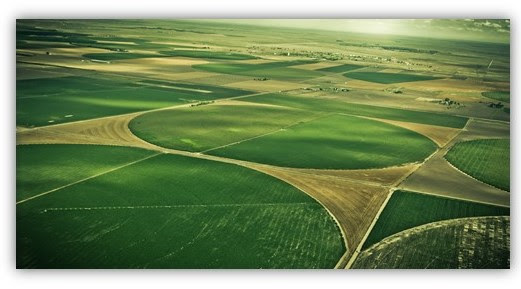
I am reminded in this season of life of a trip I took a few years ago, traveling across parts of Oregon heading to a family wedding. There was plenty of time to watch the scenery pass on by. Observing the geographical change from plush green, to gorge, to dry, to waving fields of wheat. Quietly, I sensed the Lord whisper to my heart, “Speak to the Corners.” Hm. Speak to the corners? Having no idea what He was referring to at first, I asked Him to SHOW me the corners.
I was made aware of the circular irrigation systems of the fields just outside my window. Studying those, I saw the corners. Green stalks of young corn, grown in a circular pattern. Then there were the dry, intentionally unattended corners of the fields. Assuming the farmers “did the math” and determined it wasn’t cost-effective to plant or water there. I sensed God saying, “THIS is not what I intend for your heart. No hidden, unhealthy, unwatered, unproductive, unfruitful—corners.”
We all have corners. Stuff tucked back, WAAAAY back into the corners of our heart. Corners, where hidden, nothing healthy and good can grow there. Concepts, perspectives, views of ourselves and unhealthy views of God. Stuffed places of wrongdoings, habits or—hurts. How do we handle the corners?
1 Samuel 24.
King Saul is in hot pursuit of David. David and his men are hiding in a cave. Far back, in the corner (if you will) they sat quietly. Saul comes into the cave for some privacy, to relieve himself. David’s men encourage him with hushed whispers, “THIS is your chance! Go ahead!” (I paraphrase). Can you imagine the split-second thoughts that may have run through David’s mind? “Yes, you are right, I am called to be King, I end this NOW! This man has lashed out at me! What have I done to deserve this?”
But NO! There wasn’t deathly violence involved. Yet, there in the dark corner of the cave, David instead, stealthily crept forward, cutting off a small corner of Saul’s robe. In this, David was quickly convicted of what he had done (*cutting at the lineage of Saul’s family, see below). I am learning, Godly conviction can be a tremendous gift. Do not deny or avoid it—lean into it! David proceeded telling the men he was wrong to do so, and they too were not to harm Saul. Taking it further, he stepped out into the light. He called out and revealed his presence to the King. In short, Saul is humbled by the “I chose not to” opportunity by David. Saul genuinely shares, “May the LORD reward you well for the way you treated me today. I know you will surely be king” (vv19, 20).
May we too be rewarded well for the (good) choices we make in the corners. Sure, there may be brief missteps here and there. Yet may we consider our thoughts, motives and actions, and make quick adjustments (like David). Knowing God knows our corners—watches our responses, awaits and invites (may I use David’s example) healthy stepping into the light—into the Presence of the King. May we take a divine pause and listen to the conviction. Not those around us, not the screaming hurt-filled voice inside our head—listen to what is right in GOD’S eyes.
God knows ALL. Regardless of how well we try to deny the reality of our corners and tuck it, shove it, even barricade it way in the back. Until one day and it will—it all spills out!
God boldly states, “Can anyone hide from Me in a secret place? Am I not everywhere in all the heavens and earth?” says the LORD” (Jeremiah. 23:24, NLT). And the Pastor of Hebrews wrote: “Nothing in all creation is hidden from God. Everything is naked and exposed before His eyes, and He is the one to whom we are accountable” (4:13).
Corners.
May we speak to our corners. Our intentionally unattended corners. May we echo the tender words of King David, “O Lord, You have examined my heart and know everything about me” (Ps. 139:1). He continues, “Search me, O God, and know my heart; test me and know my anxious thoughts. Point out anything in me that offends You and lead me along the path of everlasting life” (vv 23,24).
God wants ALL our heart, corners and all! He wants it healthy and profitable, fruitful—all for His good pleasure.
Corners count.
*The hem: It goes way back to ancient(er) days. God instructs the Israelites to wear garments with specifically designed borders, hems or fringes also known as tassels. (Nu. 15; Deut. 22; Ex 28). These fringes came to represent authority, personality, their place in society and even lineages were sewn into the hem. Noblemen of the day would sign their name, authenticating, by lifting their robe and pressing the hem into wet clay tablets—specific stitching indicating family and function. Scholars believe David was convicted because he CUT Saul’s lineage and symbolically cut the identity and authority of the Lord’s anointed. It was not God’s instruction. It was not God’s timing. Saul and David understood what had just taken place. (Read the conversation, 1 Samuel 24:8-22)
Speak to the corners.
In Him, DeDe (“Let us consider how we may spur one another on toward love & good deeds” – Hebrews 10:24).
Sacred Spaces. Those places and moments when you block out the world, the noise, the chaos and quietly bow your head. The moment offering a spiritual breath. Exhaling the exhaustion of the day or the season and inhaling His strength. A place and moment of divine recognition.
When God moves and speaks, revealing Himself to us, what is our response? Do we mark those moments on the timeline of our life, like we do when measuring the growth of our children. Or do we just give a quick nod of the head and continue on our way?
I admire those of ancient times, Abraham, Isaac, and Jacob. They had many things in common, but one, in particular stands out to me—they built altars (Genesis 12:7, 26:25, 35,14).
Moses too marked God moments. Exodus 17, he’s found sitting on top of a hill, below him the battle wages on. Joshua leads the Israelites against the Amalekites; they were winning as long as Moses kept his hands raised. When he grew tired? Aaron and Hur placed a stone under him to sit and then stood beside him, holding his arms up. They did win the battle miraculously with God ability, “Moses built an altar and called it ‘The Lord is my Banner’” (v15). It doesn’t say it in the narrative, but I can imagine Moses taking rocks and placing them on top of the large stone he sat on during the battle, marking the fight—marking the victory. A place and moment of divine recognition indeed.
An altar is a landmark of God’s presence. It declares a sacred space, sacred due to the moment, the Presence and hunger of our heart. May we be like the Patriarchs of old, may we too be altar builders. Although there may be no need to take our sandals off and culturally no longer gather various rocks and pile them in our backyard. Yet may we make some kind of recognition.
Recently while driving to work, I was impacted by my surroundings. A combine was cutting hay on my left and a field of foot tall corn on my right. Further I passed alpacas, cows, horses, and goats. Why impacted? For the last forty plus years I have lived primarily in the city in the Portland Metropolitan area. Now I drive through the country. The blessing was so overwhelming, I built an altar right there in the moment (and no, I didn’t pull over and wander through the farmers field looking for rocks) but I marked the moment by thanking God for this (out loud) and determined to remember.
Altar building: recognizing, remembering and declaring THIS is where God met with me. Honoring and worshipping He Who is faithful—He Who is worthy.
Sacred spaces.
In Him, DeDe (“Let us consider how we may spur one another on toward love & good deeds.” – Hebrews 10:24)
Having read the bible for many years, have you noticed like I have, there are a few scary verses. SCARY I tell you! Like those words in red, “I tell you, on the day of judgment people will give account for every careless word they speak” (Jesus, Matthew 12:36). Wide-eyed and hands over mouth! Or of ancient(er) days, Exodus 35:2, “The seventh day shall be your holy day, a day of sabbath rest to the Lord. Whoever does any work on it is to be put to death” (immediately dropping laundry basket). *
Yet, what about James 2:19 “You believe that God is one, you do well. Even the demons believe—and shudder!” James is speaking of faith and works; OH, but the principle! “The demons believe—and shudder!” This is the only time in scripture this word (shudder) is used, it means to tremble (with fear) fear of the outcome. We (the redeemed) are not to freak out in fear, thinking our God is going to step on us like an ant, but we are to have a FEARFUL-HOLY-REVERENCE!
Multiple times scripture tells us the demons knew Who Jesus was. Recognizing what He was. There were extreme responses (crying out, falling at His feet, pleading). The correct response. They knew their outcome. What is interesting, the opposite of the fear James mentions is confidence. Over confidence can lead to pride. I once heard pride defined as flexing before a holy God (that didn’t work out well for Lucifer).
I am fully persuaded in the world today, we are OVER confident as a whole. We are a flexing culture. We reach and grab for what is considered owed to us. We march waving banners and simply walk away when not getting our way. We (the global church) have in some ways embraced this and pulling the package into our perception of the Godly Kingdom.
We are whitewashing the relationship between Creator and creation—God and man. We tend to exercise our boldness (inappropriately) at times and consider the God of the Universe our pal and approach His presence liken to a buddy, an equal: We go into His throne room, throw our stuff on the floor and fling ourselves across the celestial couch. With one leg hanging over the arm, while reaching forward, grabbing a fist full of food from the banquet table and popping it in our mouth and speaking (with our mouth full), “Heh, how are ya?” (metaphorically speaking—yet true). I echo a dear friends’ words, “May I never allow that kind of casual brashness in my behavior.”
YES! A thousand yeses, our Holy God made provision for fellowship with Him—Jesus. His smile is mercy filled. His grace the welcome mat and we CAN come boldly to His throne.
YET!
Father forgive us, forgive me! May we, (I) never become so confident that I miss the mark of coming before You—reverently. Taking pause before I open Your Word and thumb through its pages. May my only boldness that is freely offered, take me to Your feet! No need to shudder, this outcome is GOOD, but may I truly recognize Who and what You are!
Holy reverence.
In Him, DeDe (“Let us consider how we may spur one another on toward love & good deeds” – Hebrews 10:24).
*Please note, YES, context is everything and Jesus brings forgiveness and New Covenant terms, the above verses were stated for emphasis.
Have you ever stood on the edge of the pages of your life and just shake your head in complete bewilderment and think one simple word, “HOW!” Then the rest of the frustration tumbles out, exclaiming, “But God, this … and …” continuing with a list of “can’t do’s – won’t work – not happening” statements. I know I have, especially these last couple of years. It has been the most trying and pain filled time of my life.
Even in the frustration, confusion, and pain, there is always—God. May we keep turning the pages. Believe it or not, “ButGod” (or “But the Lord”) is mentioned 325+ times in the Bible, in GOD’S favor. Looking at these verses (ALL of them) I was captivated. In the story, in the context, I saw God’s character being placed in the forefront. There were loud moments of reassurance and yet quiet whispers of His love. This is what I found; this is what I learned. In short, briefly stating, just a few from Genesis. Hang with me, this is good.
I begin with Genesis 3, Adam and Eve are in the garden, the presence of God so intimate that He literally takes walks with them. They have made decisions that resulted in significant long-term consequences (thanks guys). God is heard walking through the garden and the couple hides. “But the LORDGod called to the man, “Where are you?” (v9). God calls. He knew very well where they were, the question was intended for Adam, to consider his location, his position, and his condition before Him.
Then there’s Noah and crew, out in the big boat, floating. Floating. More floating. A man and his family all alone among the precious cargo. Obedience led them to this completely unknown. Genesis 8:1 “But God remembered Noah and all the wild animals and the livestock that were with him in the ark, and he sent a wind over the earth, and the waters receded.” God remembers. This doesn’t mean Noah temporarily slipped His mind, it means He will act on His promise. This principle rings eternally true. He will send a wind to our circumstance, His wind and resolve the flood in our life.
Next, a man by the name of Jacob, he worked hard as requested and then was treated unfairly by his father-in-law. Genesis 31:42 “But Godhas seen my hardship and the toil of my hands.” In the original Hebrew, the word seen is an imperative, meaning, we add a strong EXCLAMATION mark next to it. Not only that, but it is in the prolonged form, God has seen and will continue to see. God sees. He sees us where we are, how we are and how we are being treated. He cares. He will act. Just like He did in Jacob’s circumstance.
Joseph, the cocky favored son, who was thrown into a pit and sold as a slave by family members! Genesis 50:20 “You intended to harm me, but Godintended it for good to accomplish what is now being done and the saving of many lives.” God accomplishes. He redeems the bad and transforms for good to accomplish—His plan.
Amazing, just amazing! The Word is full of examples like these and more, many, many more. “But the LORD was my support” (2 Samuel 22:19). “But God is the strength of my heart” (Psalm 73:26). “But God promised” (Acts 7:5). “But God had mercy” (Philippines 2:27). “But God is the builder of everything” (Hebrews 3:4).
God is incredible! He is never late, never ignores and is extremely attentive to detail. Although involved with all areas of our life, He prioritizes our spiritual well-being over our comfort, opinion, or preferences (think, Jonah). He goes to extraordinary effort at times to make sure we hear Him.
If our circumstance seems frustrating, just keep turning the pages. God is still calling, remembering, seeing and accomplishing and SO much more!
For our growth and His glory.
But God.
In Him, DeDe(“Let us consider how we may spur one another on toward love & good deeds” – Hebrews 10:24).
I love the Psalms. The poetic sway of song and praise, thankfulness and yes, even repentance. Some give heavy pen so passionately, you can almost feel the author lean from the pages and grab you with a fisted hand, look you in the eye and with a raspy voice: “Turn from evil and do good!” (37:27). Ok, perhaps not the raspy voice. But be assured you will be grabbed. If not, you’re not leaning in enough.
Yet of all the Psalms, what most causes me pause is the exalting of God.
King David wrote: “I will extol You, my God, and King, and I will bless Your name forever and ever” (Psalm 145:1, ESV). To launch the twenty-one verses, he opens his worship with humility and adoration. As a king himself, with a surrendered heart–he passes the crown, “my God and King.”
“I will extolYou.” Extol, the word is pretty much obsolete these days. When was the last time we used it in a sentence? It isn’t active in our speech, prayers, or worship. (Or should it?)
There are two main emphases when praising and worshipping God in scripture: We praise Him for what He does and has done; powerful, mercy filled, His divine action to His beloved children. We worship for Who He is. Declaring Him as Superior: He is more, He is beyond, He is above all. He is!
In the Hebrew extol conveys movement, the act of raising. When extolling God, we are not only raising Him in high status over our life, but we lift His attributes as well. We grab all we know about Him and raise it as high as we can. Doing this, we are under–we are acknowledging we are lower. This is done both in word and deed. Not just in church as we raise our hands, but in how we conduct our lives.Wouldn’t it be great if it were contagious to others, as if standing and looking up and those around us are so caught by our behavior, and our focused direction, that they too, stop and look up.
When we worship and extol WHO God is, we are indeed in the act of surrendered lifting, we too–pass the crown. Raising Him high. We raise Him higher than the stuff, higher than our mess. HIGHER. David continues the psalm extolling God in His greatness, glorious splendor, majesty, His abundant goodness, righteousness and oh, (OH!) He is abounding in steadfast love!
May our life, in word and deed–extol Him. Giving Him the glory due and getting others to look up! (Sounds kinda psalmish)
In Him, DeDe (“Let us consider how we may spur one another on toward love & good deeds.” – Hebrews 10:24)
There is a cute and heartwarming story of a young mom putting her son to bed. He would wake up the next day a whole year older. As she tucks him in, she comments this is his last day to be four. All year he had been cheerfully showing folks four fingers on each hand. Asking if he understands, he enthusiastically replies, “YES! Tomorrow I’ll be a handful!” Stretching his arm up with five spread out fingers. Yes, yes indeed, a handful.
Motherhood.
Our hearts ache, agonize, celebrate and PRAY. There are hours of holding and scolding, cleaning and crying. Yet at the end of the day, as our head lies on the pillow, our heart swells with LOVE—regardless of the age, stage or distance of our children.
Mary too knew of this. Following the ever so zealous shepherd’s visit, “Mary treasured up all these things and pondered them in her heart” (Luke 2:19). Our children by no means compare to the Savior of the world, nor is the circumstance the same, and yet, we moms, on our own level, in our own way, like Mary, treasure and ponder our children. We dream, we guide, we protect what is so precious.
Motherhood.
Remember later, (Luke 2:41-51) Joseph and Mary realize they had misplaced Jesus on their trek back from Jerusalem. Can you image Mary’s heart! Finding Him three DAYS later! I remember when my son was five years old while visiting Mt Rushmore and lost sight of him for a mere sixty seconds in the crowd, only to find him no more than five feet from me. The panic, the fear—the instant pleating with God. This nurturing and caring design within us—can be the death of us!
Motherhood.
The quiet place of the heart, treasuring and pondering.
Happy Mother’s Day
In Him, DeDe (“Letus consider how we may spur one another on toward love & good deeds” – Hebrews 10:24).
* For Mom, “Give Jesus a hug for me!” (My sister, mom & myself). I had the most wonderful honor of leading my mom to Jesus. Three years later, she met Him face to face.
Earless chocolate bunnies and leftover hardboiled eggs in the frig (or out lost in the yard). Post-Easter. Now what? Do we rummage through the calendar for yet another holiday? Or plan an event to look forward to? What excites us about the future? What about—daily? May I be so bold in asking, what causes our inside to burn with excitement? What or who consumes our mind and emotions? What drives our behavior?
Post-Easter.
Jesus’ resurrection is AMAZING! WONDERFUL! DIVINE! REDEEMING! However, let’s not stop there. There is MORE! Let’s unpack this in brief summary. Stay with me, this is good!
Luke 24, it speaks of the women going to the tomb, once there they find two angels who notify them that Jesus was no longer there. He’s risen from the dead! The gals go back to tell the others. Peter, as energetic as he was, runs to go see and confirms.
Just following that, (v13) it says “Now that same day…”
The story continues to unfold. Two were walking to Emmaus, who unknown to them at first, encounter Jesus. They are flabbergasted that this Stranger didn’t seem to know what had just transpired in Jerusalem. Sharing their disappointment, “We had hoped that He was the one who was going to redeem Israel.” Going on they explained how Jesus’ body was not found. Verse 27, “Then He (Jesus) started at the beginning, with the Books of Moses, and went on through all the Prophets, pointing out everything in the Scriptures that referred to Him.” WOW! I’d love a one-on-one instant Bible study from the lips of the Master!
It wasn’t until Jesus was in their home, seated at their table, they accepted the bread He offered, that their eyes were opened. It was here they had a revelation of Who He was. Could itbe, just perhaps that as Jesus reached forward, giving the bread, the sleeve of His garment slid up and they could see His nail scarred hand? The next exact moment, Jesus disappeared. I LOVE their response, they said to each other, “Didn’t our hearts burn within us as He talked with us on the road and explained the Scriptures to us?” (v32)
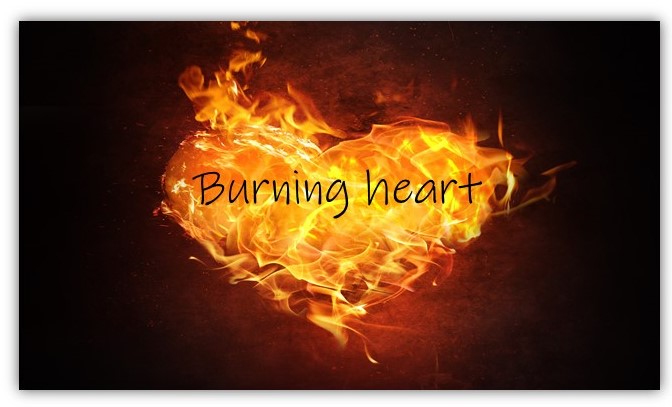
Their hearts burning within them. I want spiritual heartburn! I want my soul, my mind, and thoughts, my passions, desires, and appetites to burn with Him and His Word! The word Luke chooses to use for “burning” is very colorful. It doesn’t mean to simply strike a match and light the kindling and watch it slowly give off heat. No, it RAVISHES through the wood and consumes it! Burn Lord! Burn away the stuff. May the flame burn pure and only for You.
Notice Jesus didn’t lay hands on them or put mud on their eyes for the revelation. He didn’t drift from the shore in a boat to speak to them. He didn’t even send them to the Priest for verification! He simply—walked with them. Walking and talking. Sharing and eating. The narrative says they got up at once and went back to Jerusalem testifying that Jesus has indeed RISEN.
For us? The next time we open the Bible for devotion and study time, let’s not daydream off to another place. Let’s do some focused walking and talking. Time with God! We just need to show up for the lesson. Pay attention, take notes, and ask questions—engage in conversation. This (THIS) is the event—the daily event we will look forward to. Like the other two disciples, He will show us how His written Word pertains to HIM! For our growth and His glory!
Burn Lord, BURN within us!
Post-Easter.
In Him, DeDe (“Let us consider how we may spur one another on toward love & good deeds” – Hebrews 10:24).
Have you ever sat and read the New Testament and read ONLY the words in red—Jesus’ words? For a completely new perspective, I challenge us to do just that. I know context is everything, but let’s step out of the exegesis box (interpreting the scriptures) for a brief moment, to get an amazing snapshot of Jesus; His strength, authority, His love, and compassion.
Without all the narrative, those stand-alone red words pack a powerful punch. There are dramatic statements, strong commands, and tender words. “Let it be so.” (Matthew 3:15) “It is written.” (Matthew 4:4) “Get up.” (Matthew 9:6) “Take courage it is I.” (Matthew 14:27) “Quiet, be still.” (Mark 4:39) “Come forth.” (John 11:43) “Don’t be afraid.” (Mark 5:36) “What do you want Me to do for you.” (Mark 10:51) “Who do you say I am.” (Luke 9:20) “Then neither do I condemn you.” (John 8:11) “I am.” (John 18:6).
These are just a few, but there is one more that stands out among the rest. Especially for THIS weekend. Here I do want to set the context. Jesus is agonizingly set between two thieves. His feet and hands are nailed to a wooden cross. There at the foot of the cross, many mocked, some cried, and I am confident there were those in complete silence. After the vinegar water was offered to Jesus, He said, “It is finished.” (John 19:30) He then bowed His head and gave up His spirit. The scene is heavy, but it is also holy!
“It is finished.” Those beautiful words in red. The word in Greek is amazing! Stand back and take in the whole Technicolor filled screen. I don’t think even Steven Spielberg with all his creative genius could convey the scene that was unfolding upon humanity. “It is finished” (Tetelestai) to bring to an end—to fulfill payment. To complete something, not merely to end it, but to bring it to perfection or its destined goal. What is done corresponds to what has been said, ordered or commanded. “Not My will, but Your will be done” (Jesus, Lk 22:42). Grammatically, it is in the “perfect tense.” Meaning, the action was completed in the past. Done. Yet with results continuing in the present. Basically, “This happened, and it is still in effect TODAY.” The gift that keeps on giving! Jesus’ physical work on earth was completed, and Scripture was fulfilled.
As Jesus said this, His blood flowing down His forehead, from His hands and His feet. His sacrifice now eliminates the debt owed by mankind (you and me). May we take careful notice, Jesus didn’t say “I am finished.” That would imply He is a mere man and dies defeated. What was finished was not Jesus’ life—it was everything keeping us from God, the Father.
“It is finished.”
Jesus is ultimately laid in the tomb. Where God spares NO detail. Looking back, instructions for building the Tabernacle and the divine furniture, “Make the atonement cover of pure gold… Make two cherubim out of hammered gold at the ends of the cover. Make one cherub on one end and the second at the other end” (Exodus 25:17-19). HERE the blood sacrifice was placed by the Priest (Leviticus 16:14). Fast forward, John 20:12, Mary “saw two angels in white, sitting where the body of Jesus had lain, one at the head and one at the feet.” Because of blood—Jesus’ blood, God’s requirement of sinful man is now satisfied. HE is the Lamb of God. HE is our High Priest.
When Jesus rose from the dead and the stone was found rolled away, it was NOT so He, the Son of God, Who walked on water, could get out. It was so mankind could get in! Get in and see “He isn’t here! He is risen from the dead, just as He said would happen. Come, see where His body was lying” (Matthew 28:6).
Jesus rises from the dead triumphantly (Happy Easter) the bridge back to the Father is perfected. The plan, the process of God. He engages and commissions the disciples. He returns to heaven to reign (But He’s coming back!) Does it end here for us? No. Now we the church with the authority given by Jesus Himself, and with Holy Spirit power, we carry on with the red-letter commands, statements, and tender words.
Move over Easter Bunny, here comes the risen King! Let’s all stand to our feet! With loud shouts of praise, and enthusiastic applause! “It is Finished!
Jesus said He’d rise again—He did. He said He’d come back again—He will.
Blessings,
In Him, DeDe (“Let us consider how we may spur one another on toward love & good deeds“- Hebrews 10:24).
“Six days before the Passover…” Mary took a pint of perfume and poured it on Jesus’ feet—the house filled with the fragrance (See below—the perfume, “myrrh”). The narrative describes the triumphal entry (Palm Sunday) “The next day” (John 12). It is safe to say Jesus still smelled quite fragrant from the oil. This being of Jewish telling, in Jewish culture, whilst Jewish people stood on the road as Jesus passed by, they (potentially) smelling the fragrance, resonated the Kingly procession, as they shouted, “Hosanna! Blessed is He who comes in the name of the Lord! Blessed is the King of Israel (v13).
Anointing was a priestly and kingly custom: Moses pouring oil on Aaron’s head (Lev 8:12) and Samuel over Saul (1 Sam 10:1) and the anointing of David (1 Sam 16:13). Interestingly, Mary anoints Jesus’ feet. Could it be (just an observation) the anointing of His feet, not His head, was displaying the declared Majesty of God—on earth. His Kingly walk among man, “The Word became flesh and made His dwelling among us. We have seen His glory, the glory of the One and Only, who came from the Father, full of grace and truth” (John 1:14).
Later as Jesus rides through the cobblestone streets, the crowd begins to yell “Hosanna,Hosanna in the Highest” waving palm branches with enthusiasm. It was common practice in the ancient world to welcome home a king or war hero by laying down branches in front of them, similar to our ticker tape celebrations today. Hosanna is the Greek version of the Hebrew saying “yasha na” meaning “Save now we pray.” This is taken from what is known as the Hallel, (Jewish prayerful readings of Psalms 113-118) specifically here, “O LORD, save us; (HOSANNA!) O LORD, grant us success. Blessed is he who comes in the name of the LORD” (Psalm 118:25, 26, emphasis mine). Can we grasp the impact of what they were seeing and saying? Jesus was fulfilling the prophetic words of Zechariah, “Rejoice greatly, O Daughter of Zion! Shout, Daughter of Jerusalem! See, your king comes to you, righteous and having salvation, gentle and riding on a donkey, on a colt, the foal of a donkey” (9:9).
However, just four chapters later, people were yelling again, but this time; “Crucify Him! Crucify Him!” (Mark 15:12-14). Little did they know they were basically yelling the same thing. Both times! For you see, for Jesus to “save we pray” they had to “Crucify Him!” —He allowed it. He laid down His life for YOU and for me. By this act and His resurrection from the dead with all Kingly authority and power, He bridged the gap between man and His God. He is the Restorer of fellowship—God and His children, mankind.
This weekend, may we not allow this moment to pass us by, as we whole-heartedly consider the impact and fulfillment of Hosanna. JESUS! He rides an untamed colt in a King’s procession, “SAVE WE PRAY!” THAT He did!
In Him DeDe (“Let us consider how we may spur one another on toward love & good deeds” – Hebrews 10:24).
“This is real love—not that we loved God, but that He loved us and sent His Son as a sacrifice to take away our sins” (1 John 4:10, NLT).
Remember as a child sliding the crayon on a white piece of paper, from one dot to another until getting to the last dot, excited to see a picture form? This is often how we come to understand certain things—connecting the dots. Have we considered the “dot connection” (if you will) of the Lamb of God? As we draw near to Easter, let’s pick up our crayon and begin connecting as we see the progression of the Lamb.
Genesis 22: God declares to Abraham to take his son Isaac, his only son to the mountain and offer him as a sacrifice. As Abe and son begin their hike up the mountain, father placing the wood on the shoulders of the son, Isaac says, “The fire and wood are here,” then asks, “But where is the lamb?” Abraham confidently responds, “God Himself will provide the lamb.” As the story progresses, Isaac is on the altar, Abraham obeys to the fullest. God knowing his heart, stops him and in substitution, provides a male lamb for the sacrifice. The lamb provided.
Exodus 12: God prepares the Israelites to leave the captivity of Egypt. Instructions were given as the Angel of Death would soon be unleashed. “Take the lamb” slay and place the blood of the lamb on the doorpost of the home. The blood now over them—death avoided. The lamb protected.
John 1: John the Baptist, known as an eccentric evangelist and prophet, sees Jesus approaching; he openly declares, “Look, behold the Lamb of God, who takes away the sin of the world.” John purposely points to Jesus, the shift of attention—to the divine. The Lamb proclaimed.
John 19: Jesus is hung on a cross, just before His last breath, He states, “It is finished” (v30). Jesus, the Lamb of God is the propitiation (atonement) for our sins, (1 John 2:2, Ro 3:23-25) meaning that through His death on the cross, God’s wrath is satisfied, and forgiveness and reconciliation is offered to mankind. The Lamb propitiated (Big fancy theological word).
Revelation 5: The heavenly citizens declare before the throne, “Worthy is the Lamb who was slain to receive power and wealth and wisdom and strength and honor and glory and praise” (v12). THAT verse! Read it again as Holy Spirit breathes on you with His Majesty! Let’s all stand to our feet! The Lamb PRAISED!
As we enjoy dark chocolate with cream filled eggs (I SO love Easter candy) let’s take these next few days building up to Easter—our dots connected, as we wholeheartedly consider the Lamb of God. The blood stained cross. The empty tomb. Focusing, seeing, understanding and participating in the celebration of Jesus. What a powerful reminder of God’s love and grace, as well as the profound cost of our redemption.
It’s not about the bunny—it’s about the LAMB!
The lamb provided, protected, proclaimed, propitiated and praised.
Worthy is the LAMB!
In Him, DeDe (“Let us consider how we may spur one another on toward love and good deeds”– Hebrews 10:24).
Genesis 22, Abraham and Isaac are on the mountain. Here in the narrative, woven in this story: love, worship and obey are first used in scripture. The law of first mention often sets the tone for all other uses.
I noticed today that the word used for “fear” (22:12) God stopping Abe mid-air when he was fully obeying and ready to sacrifice Isaac, responds saying, “I know that you fear God, and have not withheld your son from Me, your only son.” This is the first time fear (yare) is used as an adjective (other uses are verbs). Why spotlight this? I am challenged! Here’s why. In Abe’s story, it wasn’t so much that he feared (although KEY to note) but that “he” feared. The emphasis is on the one doing, describing Abe’s perception of his God (in the moment, moral reverence). Reverence is fear mingled with respect and utmost awe. May we be aware of our “utmost” usage!
Perception.
Perception can often be interchangeable with discernment. See and understand with a weighing process. Wisely distinguishing value and worth and responding accordingly. Perception profoundly shapes our thoughts, feelings, and behavior, influencing how we interact with others—with God. How we react in circumstances and the decisions we make. Abraham valued his God, and his behavior tethered alongside.
Our perception of God dictates our obedience.
A.W. Tozer wrote, “What first comes to mind when you think about God is the most important thing about you.” [Knowledge of the Holy]. Abraham revered God; it was evident. God met him in the moment. “YOU, Abe, I know you fear Me” (paraphrased).
Like Abraham, what and how does our behavior display our perception of God? If we could hear God audibly in the moment, what would God’s response be to us? (OH! That is so challenging!)
Perception.
In Him, DeDe (“Let us consider how we may spur one another on toward love & good deeds” – Hebrews 10:24).













 Inspired Fountain